How to Start English at Home with Your Child: A Practical First Week
Starting English at home can feel easier when the next activity is already chosen. These five linked sessions reuse a book, ball, cup and shoe in finding, passing, hiding and picture games. Repeat or spread them out to suit your child; no reading or printed kit is needed.
- Learning language
- English
- Age
- Ages 3–10

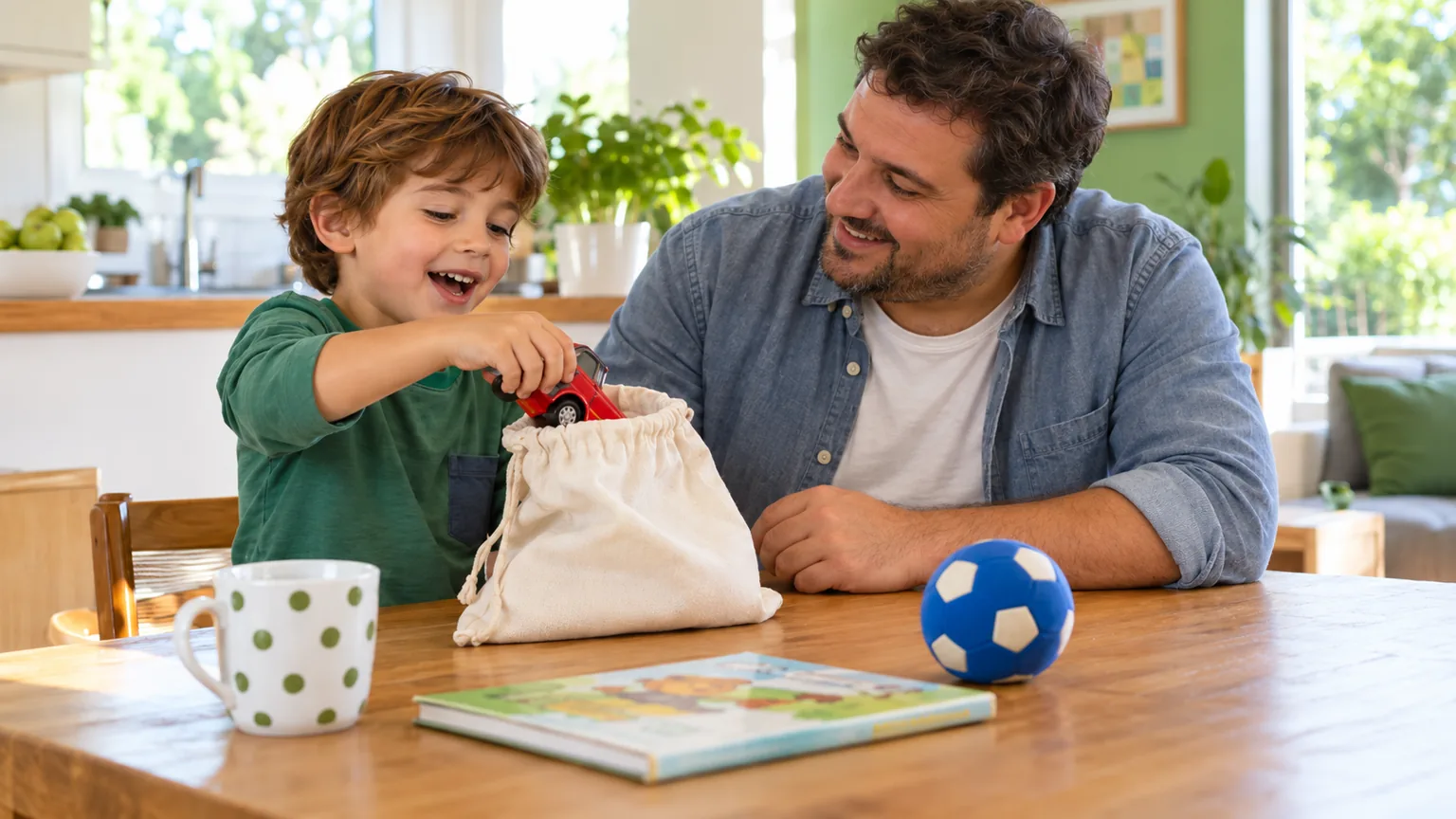
A familiar moment and four everyday objects are enough: a book, a ball, an empty cup and a clean shoe. Add a bag or box and, later, simple drawings of the same objects. You can explain the rules in your home language. If you are unsure of a word, check a dictionary recording before playing.
Keep a few phrases at hand: “Look.” “Show me the book.” “Give me the cup.” “Put it here.” “My turn.” “Your turn.” Say the phrase while showing what it means. You do not need to use every phrase in the first session.
A book can be held up, a ball can be rolled, and “Put it here” can go with a pointing gesture. Start with two objects if four distract your child. For an older beginner, use four objects from an interest such as drawing or sport. Keep the same words across the next activities.
These sessions can fit five days, take two weeks, or become one favorite game you repeat. Around five minutes is a possible starting point; stop sooner or continue while your child wants to play. This is an example routine, not a deadline for learning four words.
1. Find and point
- Goal
- Connect spoken words with familiar objects.
- Preparation
- A book, ball, cup and shoe; begin with two.
Steps
- Hold up an object and name it: “Book.” Put it down and name the other one.
- Point as you say “Show me the book.” Let your child point, look toward it or pick it up.
- Change the positions. Add the other objects when the first pair is familiar.
- Swap roles: your child chooses an object, and you name or find it.
- Adult help
- Demonstrate the response. A gesture is enough; speaking is optional.
- Easier variation
- Use two objects and point together.
2. Give and put
- Goal
- Use the same words in a request.
- Preparation
- The four objects and a box.
Steps
- Model “Give me the book” with a gesture. Take it and say “Thank you.”
- Ask for another object: “Give me the cup.”
- Point to the box and say “Put it here.” Help with the action if wanted.
- Let your child lead. If they say “ball,” respond “Give me the ball” and pass it.
- Adult help
- Model a fuller phrase without requiring a repeat.
- Easier variation
- Use one object and one request.
3. What is missing?
- Goal
- Recognize a familiar word when its object is hidden.
- Preparation
- The objects and a cloth or bag.
Steps
- Name the objects together. Ask your child to look away while you hide one.
- Ask “What’s missing?” Offer “Book or ball?” if the question is unfamiliar.
- Accept a word, a matching drawing or pointing to where the object was.
- Reveal and name it. Swap roles so your child hides an object for you.
- Adult help
- Reveal it when guessing becomes frustrating; there is no pass mark.
- Easier variation
- Let your child watch you hide one of two objects.
4. Object to picture
- Goal
- Recognize a word in a drawing as well as a real object.
- Preparation
- Simple drawings or photos of the same book, ball, cup and shoe.
Steps
- Place an object beside its picture and say its word.
- Put the objects aside. Ask “Show me the cup.”
- Move the pictures and repeat a familiar request.
- Turn a picture over and reveal it. Ask “What is it?” only if your child wants a speaking turn.
- Adult help
- Your own sketches are enough; no printed set is needed.
- Easier variation
- Keep the real objects next to two pictures.
5. Treasure bag
- Goal
- Reuse the requests in a mixed game.
- Preparation
- The same objects in a bag.
Steps
- Say “Find the book” and let your child feel for it before taking it out.
- If a different object appears, name it: “That’s the cup. Let’s find the book.”
- Switch roles. Let your child choose a word or point to a drawing as your clue.
- Finish by choosing a game to repeat another day.
- Adult help
- If feeling for objects is uncomfortable, open the bag and choose by looking.
- Easier variation
- Keep two objects visible and take turns choosing.
If a request is unclear, show the action. If your child answers “Book,” you can reply “Yes, the book. Give me the book.” Recognizing an object, joining a gesture or asking to play again tells you what to repeat; it does not measure overall English ability. Read more about helping when your own English is limited.
Reduce the objects or repeat a familiar session before adding language. For an action break, demonstrate “jump,” “clap,” “sit” or “stand,” one at a time. Your child can move a toy or make a small gesture instead. Four preschool activities offers more ways to adapt play.
Once ball and shoe are familiar, read and listen to Where Is the Blue Ball?. For a fuller discussion of length and stopping, see how many minutes to practise.
British Council home guidance recommends routines, games, familiar objects and repeated phrases. Research on vocabulary learning also gives reasons to connect words with meaning, but it does not validate this five-session plan. The Cochrane review concerns varied L2 interventions up to age six; the gesture-and-picture experiment listed below studied eight-year-olds in a classroom. Neither sets a timetable for your child.