Greetings and polite words in English for children
Hello and hi greet someone; goodbye and see you end a conversation. Please helps make a request, and thank you shows gratitude. Practise these English expressions in a short exchange, with one person greeting, asking or offering and another replying.
- Learning language
- English
- Level
- beginner

A greeting needs a person to greet, and a thank-you needs something to respond to. A toy visitor or a paper character can supply that situation at home. You can model both sides first, then let your child choose a line or respond with a wave.
| English | Pronunciation (US IPA) | Meaning or use | Example |
|---|---|---|---|
| hello | /həˈloʊ/ | A greeting when meeting someone. | Hello, Sam. /həˈloʊ, sæm./ |
| hi | /haɪ/ | An informal greeting. | Hi, Alex. /haɪ, ˈæləks./ |
| good morning | /ɡʊd ˈmɔɹnɪŋ/ | A greeting used in the morning. | Good morning, Maya. /ɡʊd ˈmɔɹnɪŋ, ˈmaɪə./ |
| goodbye | /ɡʊdˈbaɪ/ | A farewell when leaving. | Goodbye, Sam. /ɡʊdˈbaɪ, sæm./ |
| see you | /si ju/ | An informal farewell. | See you! Bye! /si ju! baɪ!/ |
| please | /pliz/ | Used with a request to make it more polite. | A pencil, please. /ə ˈpɛnsəl, pliz./ |
| thank you | /θæŋk ju/ | Used to show gratitude. | Thank you for the picture. /θæŋk ju fɔɹ ðə ˈpɪktʃɚ./ |
| you're welcome | /jʊɹ ˈwɛlkəm/ | One way to reply to thank you. | Thank you. You're welcome. /θæŋk ju. jʊɹ ˈwɛlkəm./ |
| sorry | /ˈsɑɹi/ | Used for an apology. | Sorry. I dropped your picture. /ˈsɑɹi. aɪ dɹɑpt jɔɹ ˈpɪktʃɚ./ |
| excuse me | /ɪkˈskjuz mi/ | Used to get attention politely or interrupt. | Excuse me. Can you help me? /ɪkˈskjuz mi. kæn ju hɛlp mi?/ |
Broad US IPA is a reading aid. Listen to the audio for connected speech.
Good morning greets someone in the morning. Good night usually belongs to a farewell at the end of the day or bedtime; it is not the usual greeting on arrival. Cambridge: greetings and farewells.
| English | Pronunciation (US IPA) |
|---|---|
| Hello. My name is Alex. | /həˈloʊ. maɪ neɪm ɪz ˈæləks./ |
| Hi, Alex. I'm Sam. | /haɪ, ˈæləks. aɪm sæm./ |
| Can I have the book, please? | /kæn aɪ hæv ðə bʊk, pliz?/ |
| Here you are. Thank you. | /hiɹ ju ɑɹ. θæŋk ju./ |
| You're welcome. | /jʊɹ ˈwɛlkəm./ |
| Goodbye. See you! | /ɡʊdˈbaɪ. si ju!/ |
Broad US IPA is a reading aid. Listen to the audio for connected speech.
You're welcome is short for you are welcome. Keep it as a reply to thanks. Please belongs with requests or acceptance, and does not usually replace you're welcome after thank you. Cambridge: please and thank you.
Cambridge shows final-syllable stress in hello: UK /heˈləʊ/, US /heˈloʊ/. Please ends with a /z/ sound in /pliːz/. See hello and please.
Model a friendly whole exchange, including a pause for the other person's turn. Avoid making a child repeat an isolated line until it sounds identical. A wave, a pointing choice or a reply in your home language can keep the conversation moving.
- [Family members in English for kids: words and games](/learn/family/)
- [How to Encourage Your Child to Speak English](/en/guides/get-your-child-speaking/)
- [How to Help Your Child Learn a Language When You Do Not Speak It Well](/en/guides/help-child-learn-language-when-parent-does-not-speak-it/)
Play: Greetings and polite words in English for children
Keep learning through play — the Nativik app has even more learning games and adventures. Try it!
English practice in Nativik spans different play contexts. You can add a greeting to your own time together: say "Hello" before playing and "Goodbye" when you finish. Let a toy join the conversation if your child prefers to greet a character. These little exchanges belong to the routine you create together.
Agree which character is arriving, leaving or asking for something. Explain that situation in your home language, then use one short English exchange. Keep the tone natural; the activity is practice with phrases, not a test of a child's manners.
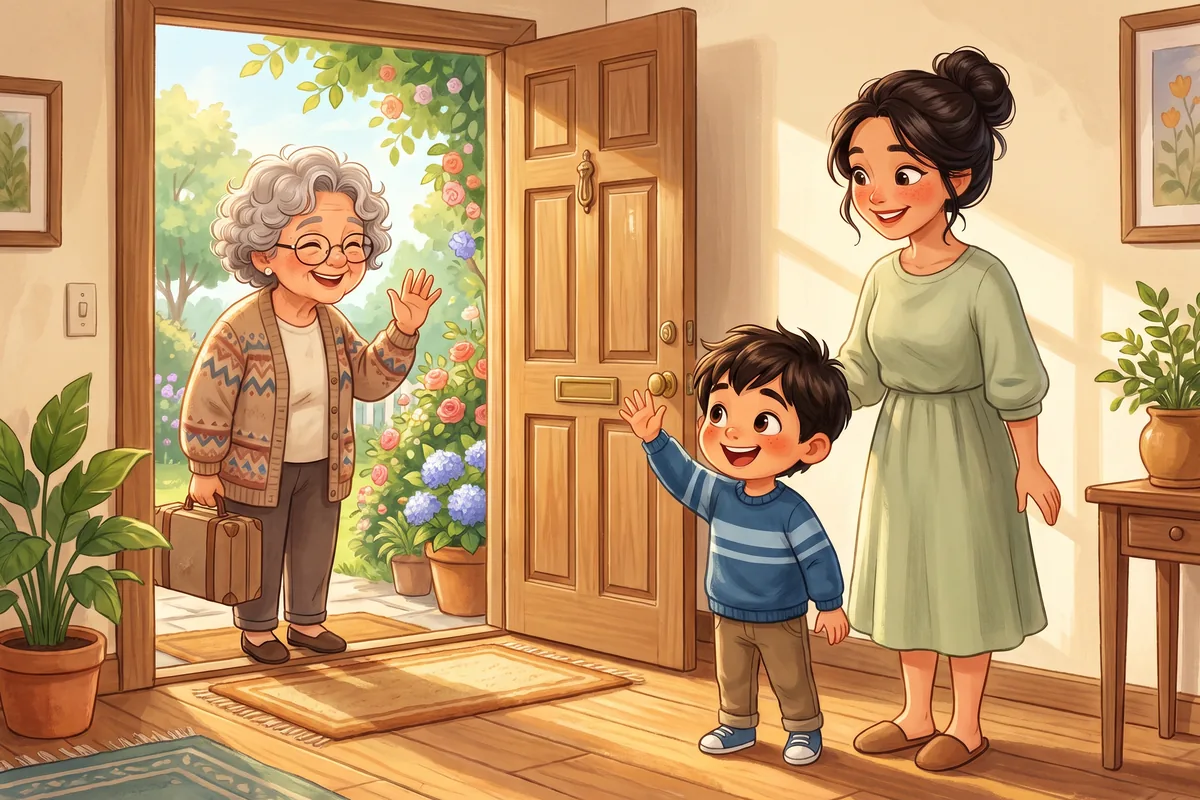
A visitor at the paper door
- Goal
- Match a greeting to arrival and departure.
- Preparation
- Draw a door and two characters, or use toys already suitable for your child.
Steps
- Move one character to the door and say, "Hello." Give the other character a reply.
- Let your child move the visitor inside, or wave to greet it.
- When the visitor leaves, model "Goodbye" or "See you". Swap roles.
- Adult help
- Your child can direct the characters while you provide both voices. Do not require contact, a wave or a spoken greeting.
- Easier variation
- Use hello and goodbye only.
Pass the picture
- Goal
- Practise a request and thanks.
- Preparation
- Put two drawings between you.
Steps
- Model "Can I have the book, please?" while pointing to a book drawing.
- Pass it and say, "Here you are." Add "Thank you" and "You're welcome" using two character voices.
- Invite your child to choose a drawing and take either turn.
- Adult help
- Pass the picture even if the child does not say please. Supply the line as a model.
- Easier variation
- Use "A book, please" and "Thank you" while passing the book picture.
Which line fits?
- Goal
- Choose language for a small situation.
- Preparation
- Draw a character arriving, leaving and needing help.
Steps
- Describe one scene in your home language.
- Offer two English choices: "Hello" or "Goodbye" for the arriving character.
- Play out the chosen line. For the help scene, model "Excuse me. Can you help me?"
- Adult help
- Use clear fictional situations, and explain a choice instead of marking social behaviour right or wrong.
- Easier variation
- Act out only arrival and leaving.
Should my child always answer "I'm fine"? You can model that common reply, but the child may prefer "I'm happy", "I'm tired" or no answer. A greeting activity does not require a personal report.
Is hi less polite than hello? Hi is more informal. For a first activity, hello works in many ordinary greeting situations. Explain the setting when another expression is expected.
What if my child will not greet someone in English? Use fictional characters and give the child control of their turn. Avoid making a real meeting depend on performing the practised phrase.