Transport in English: vehicle words for children
Car, bus, train, bike, boat and plane are common transport words in English. Use them in short lines such as "I go by bus" or "I can see a train." A paper journey lets children practise the words even when a vehicle is unfamiliar in daily life.
- Learning language
- English
- Level
- beginner
A child may know a bus from a journey, a helicopter from a picture and a boat from a story. You can bring those experiences together on a simple map. The words below let you name vehicles, talk about travel and choose a pretend way to reach a place.
| English | Pronunciation (US IPA) | Meaning or use | Example |
|---|---|---|---|
| car | /kɑɹ/ | A road vehicle commonly used for a small group of people. | I can see a car. /aɪ kæn si ə kɑɹ./ |
| bus | /bʌs/ | A large road vehicle that carries passengers. | We go by bus. /wi ɡoʊ baɪ bʌs./ |
| train | /tɹeɪn/ | Connected railway vehicles moving along tracks. | The train is at the station. /ðə tɹeɪn ɪz æt ðə ˈsteɪʃən./ |
| bike | /baɪk/ | Short for bicycle in this activity. | This is my bike. /ðɪs ɪz maɪ baɪk./ |
| boat | /boʊt/ | A vehicle for travelling on water. | The boat is on the lake. /ðə boʊt ɪz ɑn ðə leɪk./ |
| plane | /pleɪn/ | Short for aeroplane or airplane. | I can see a plane. /aɪ kæn si ə pleɪn./ |
| truck | /tɹʌk/ | A road vehicle used to carry goods. | The truck is on the road. /ðə tɹʌk ɪz ɑn ðə ɹoʊd./ |
| helicopter | /ˈhɛlɪkɑptɚ/ | An aircraft with rotating blades above it. | The helicopter is in the sky. /ðə ˈhɛlɪkɑptɚ ɪz ɪn ðə skaɪ./ |
Broad US IPA is a reading aid. Listen to the audio for connected speech.
Truck and lorry can name the same kind of goods vehicle; lorry is the British English variant in the Cambridge list. Here, bike means bicycle. The drawings and context make these meanings clear.
| English | Pronunciation (US IPA) |
|---|---|
| I can see a bus. | /aɪ kæn si ə bʌs./ |
| We go by train. | /wi ɡoʊ baɪ tɹeɪn./ |
| I go by bike. | /aɪ ɡoʊ baɪ baɪk./ |
| I walk to the park. | /aɪ wɔk tə ðə pɑɹk./ |
| Where is the boat? | /wɛɹ ɪz ðə boʊt?/ |
| It's on the water. | /ɪts ɑn ðə ˈwɔtɚ./ |
Broad US IPA is a reading aid. Listen to the audio for connected speech.
For a way of travelling, use by without a or the: "by bus", "by train", "by bike". When pointing to one particular vehicle, use the usual noun phrase: "a bus" or "the bus". You can practise the travel phrase as a complete chunk.
Bus has one syllable in the UK and US form /bʌs/ in the Cambridge entry. The plural buses has an extra syllable. Model "a bus" and "two buses" using drawings, so the difference has a visible meaning.
Say each vehicle name on its own before putting it in a travel phrase. Check a long word such as helicopter in a learner's dictionary if you are unsure. Your child can move a picture without repeating the word.
- [Colors in English for Kids: Words and Two Simple Games](/learn/colors/)
- [Numbers in English for Kids: 0–20](/learn/numbers/)
- [How to Help Your Child Learn a Language When You Do Not Speak It Well](/en/guides/help-child-learn-language-when-parent-does-not-speak-it/)
Play: Transport in English: vehicle words for children
Keep learning through play — the Nativik app has even more learning games and adventures. Try it!
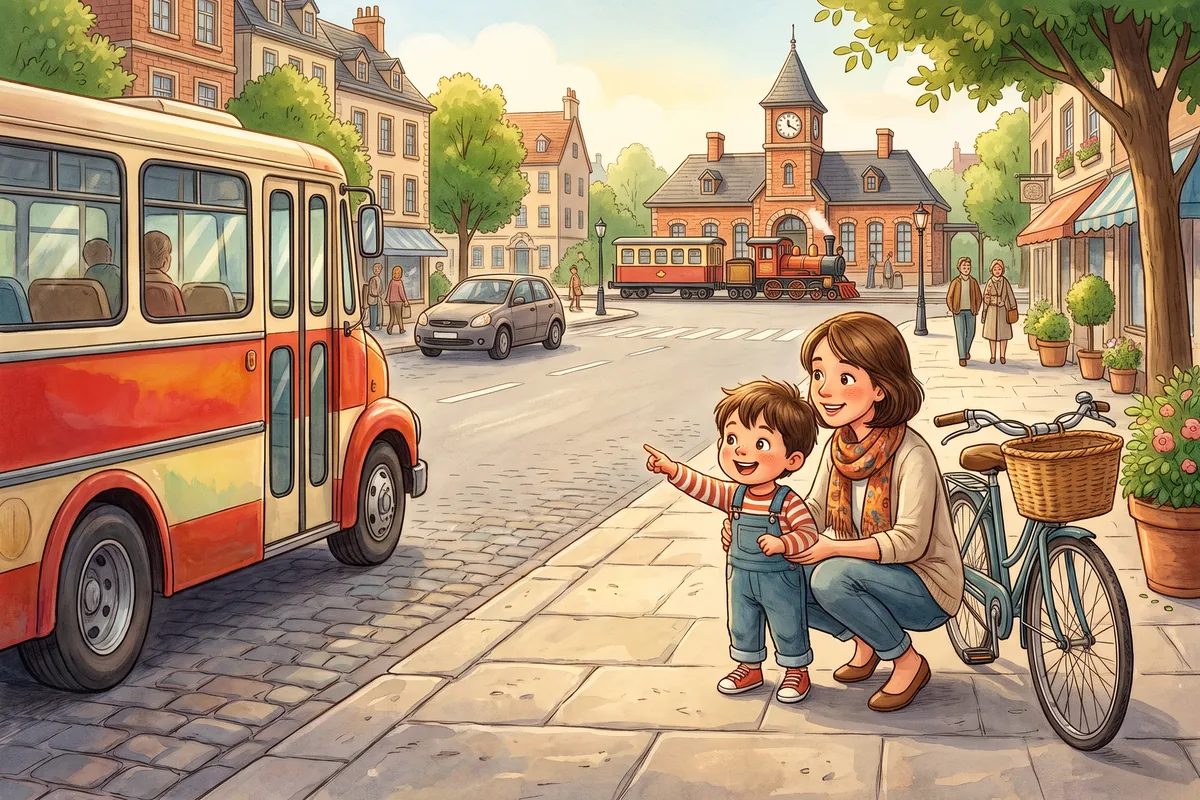
Transport appears in Nativik's city scene, where cars and buses pass the shops. Watch for a bus together and use the line "I can see a bus." Your child can point or name the next vehicle they recognise. Afterwards, add that vehicle to the paper journey below and decide where it goes.
Keep journeys on paper for these games. Use drawings large enough to move easily; arrows can stand for roads or tracks. The language activity is separate from learning real road or travel rules.
Road, track, water, sky
- Goal
- Connect vehicle words with a pictured route.
- Preparation
- Draw a road, railway track, lake and patch of sky, plus vehicle pictures.
Steps
- Put a bus on the road and a boat on the lake, naming them.
- Invite your child to place another vehicle. Describe it: "A train."
- Ask a small question such as "Where is the boat?" and let the child point.
- Adult help
- Acknowledge pretend choices; explain that the drawing is a game, not a guide to where real vehicles can safely go.
- Easier variation
- Use only bus and boat.
Plan a paper journey
- Goal
- Use "by" in a short travel phrase.
- Preparation
- Draw two places connected by a pretend road and track.
Steps
- Move a person picture to the first place. Say, "We go by bus."
- Let your child choose bus or train for the next journey.
- Move the chosen vehicle and say the matching phrase. Swap roles for the return trip.
- Adult help
- Keep the route fictional. A real journey can have different options, distances or access needs.
- Easier variation
- Name the chosen vehicle without the full sentence.
The window view
- Goal
- Use "I can see...".
- Preparation
- Make a paper frame and place two vehicle pictures behind it.
Steps
- Look through the frame and say, "I can see a car."
- Let your child move a picture into view. Name the vehicle or use the full line.
- Change pictures and invite the child to decide what comes past next.
- Adult help
- Do this while stationary at home. Avoid turning a real journey into a task that distracts an adult responsible for travel.
- Easier variation
- Reveal one picture and say its name together.
Is transport or transportation correct? Both name the topic. Transport is common in British English and transportation is common in American English. The vehicle words are useful with either heading.
Does bike always mean bicycle? Context matters. In this guide and its pictures, bike means bicycle. Use bicycle when you want to be explicit.
What if we do not use these vehicles? Use a story or pretend map. A child can recognise a vehicle word without needing to travel in that vehicle.