Colors in English for Kids: Words and Two Simple Games
From clothes to toy cars, colors give you plenty of everyday things to talk about in English. This guide introduces 11 color words with example phrases and two games to play at home. You can also explore how colors appear in Nativik's city scene.
- Learning language
- English
- Age
- Ages 3–10
- Level
- Beginner
This guide is for a parent helping a beginner child aged 3-10. Choose colors you can show clearly; the word list is a reference, not a list to memorize in one sitting.
Match the words to what you actually see. A ball can have several colors, and an apple need not be red. For a patterned object, point to one part or name two colors: "It's red and blue." These examples describe particular objects, not every object of that kind.
Use these lines in either game, changing the color to match your object or picture. Model both the question and the answer; your child does not have to say every line.
- "Look! It's red." — Show an object and name its color.
- "Point to blue." — Invite a pointing response.
- "Find something yellow." — Give a color-hunt request.
- "What color is it?" — Ask about the object you are showing.
- "It's green." — Model a short answer.
- "Red or blue?" — Offer two visible choices.
- "Blue, please." — Request a color for the drawing.
- "It's red and blue." — Describe two colors together.
Start by saying one color while pointing, then use it in a phrase: "Blue. It's blue." Invite your child to join you, but keep the game moving when they prefer to listen.
Yellow and purple each have two syllables, with the first syllable stressed in the main pronunciations listed by Merriam-Webster.
Try two gentle taps as you say either word, making the first part stronger. The linked dictionary entries offer an optional pronunciation reference for the adult; no recording or device is needed to play. Do not turn each attempt into an accent test.
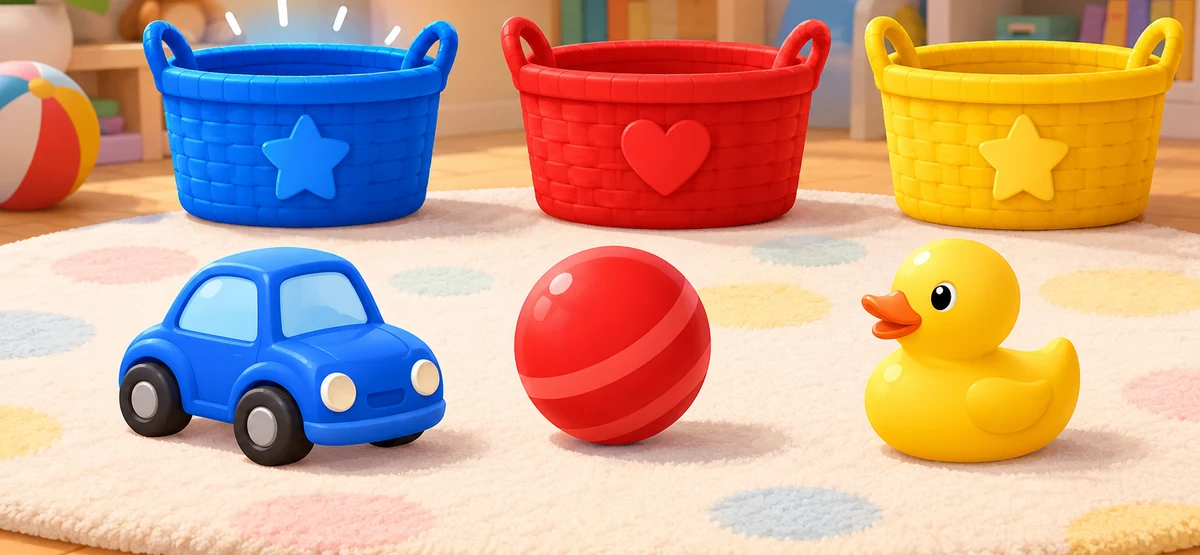
Play: Color sorting baskets
Cars of different colors drive through the city in Nativik. Our language practice follows a hear-then-say sequence, so your child gets to listen before trying the words aloud. When you play together, you can point to a passing car and ask, "What color is that car?" The cars give you something on screen to connect with the color words on this page.
The British Council recommends short, repeated English practice using everyday situations and household objects. The games below are original suggestions, not activities tested or endorsed by that source.
Play one game, pause when your child has had enough, and reuse familiar colors another day. Pointing is the simpler option; for more practice, invite your child to give you a request or describe two colors. These are choices, not age-based milestones.
1. Color hunt
- Goal
- Connect a spoken color word to a familiar object.
- Preparation
- Choose two colors, such as red and blue. Find large, familiar objects in those colors in one room, visible without climbing. Use objects you can point to without moving them; the adult stays with the child.
Steps
- Point to your first object and say, "Look! It's red." Use its actual color.
- Say, "Point to blue." Let your child point, walk with you to look, or say "blue." Show the answer together when needed.
- Show another object in one of your chosen colors. Ask, "What color is it?" Offer "Red or blue?" and point to your earlier examples as choices. Accept a point or a word.
- Switch roles: let your child point to a target for you to name, or give you a spoken request. In a later round, swap in another table color, using a line such as "Find something yellow."
- Adult help
- Leave heavy or breakable objects in place. When an answer differs from the color you are showing, point and model the word again without keeping score. For a patterned object, show the part you mean.
- Easier variation
- Use one object. Say its color while you both point; there is no need to answer a question.
2. Choose my drawing
- Goal
- Use the same color words to make a choice and direct the adult.
- Preparation
- The adult draws a large, simple house with empty areas and adds two colored sample patches at the edge of the paper. Reuse the hunt's colors. The adult handles the drawing tools; no printed sheet is needed.
Steps
- Point to an empty area, then to the two patches. Ask, "Red or blue?" Substitute your selected colors.
- Let your child choose by pointing to a patch, naming the color, or saying "Blue, please."
- Fill that area with the chosen color and describe it: "It's blue." Repeat with another area, following your child's choices.
- Look at the finished picture together. Model "It's red and blue" when those are its colors. For more practice, offer one additional color from the table and let your child direct another part.
- Adult help
- Point to each area so your child does not need to know words for house parts. Follow the chosen colors even when they are unusual for a house; this is not a realism test.
- Easier variation
- Offer one color patch. Let your child point while you name the color and fill one area.
Which colors should we try first? Try red and blue when you have clear examples nearby. Green and yellow are possible additions, not a required next step. A different pair from the word list is fine when it fits your child's familiar objects.
What if my child only points? Count pointing as participation in these games: name the selected color and carry on. You can model a short answer without demanding repetition.
Which spelling should we use? Use color and gray for US English; UK materials usually use colour and grey for the same meanings. These are spelling differences, not extra colors.
Are flashcards required? No. The hunt uses things already in the room, and the second game uses an adult-made drawing. Your child can join both without reading or writing.
The vocabulary is an editorial selection of 11 everyday color words, checked against dictionary color senses. Practice pairs those words with visible objects, adult modeling, pointing, and optional short phrases.
The vocabulary list is a reference for choosing words that fit your child’s interests and everyday surroundings.
Dictionary links support meanings, spelling, and the pronunciation note; British Council guidance informs the parent-led approach. The object examples and game instructions are editorial material. Sources were consulted on October 13, 2026.