Animals in English for Kids: 12 Names and Two Games
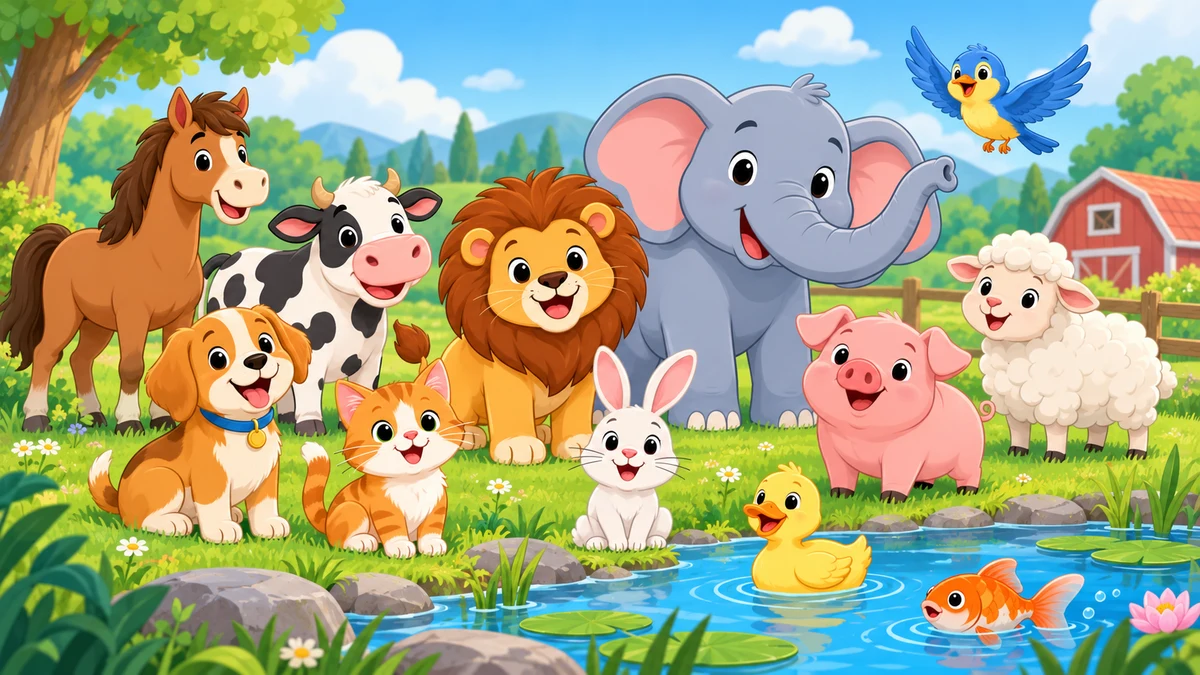
Animals turn up in picture books, toys and everyday conversations, giving you familiar things to name together in English. This guide brings together 12 animal names, useful phrases and two games with simple drawings, so you can introduce the words through play at home.
- Learning language
- English
- Age
- Ages 3–10
- Level
- Beginner
Start with animals your child recognizes, such as a cat and a dog. Point to a picture, say the word and invite your child to say it with you.
For picture themes, try pets with cat, dog, bird, fish, or rabbit; a farm with cow, horse, sheep, pig, or duck; and a wild-animal scene with lion or elephant. These are drawing prompts, not rigid biological groups. The same word can appear in different settings.
Use phrases that match your picture: "The bird can fly" works for a flying bird. These activities use drawings and imagined situations; they do not require handling real animals.
Pick one adult prompt and one answer to repeat during a game. Point as you speak, and model both parts before inviting your child to take a turn. Use "It's an elephant" as a complete model rather than stopping the game for a grammar explanation.
- **Adult:** "Point to the cat."
- **Adult:** "Where is the dog?"
- **Adult or child:** "It's a cat."
- **Adult or child:** "It's a dog."
- **Adult or child:** "It's an elephant."
- **Adult or child:** "The bird can fly."
- **Adult or child:** "The fish is in the water."
- **Adult:** "What's missing?"
- **Adult or child:** "Two sheep."
For counting drawings, use "one sheep, two sheep" and "one fish, two fish." Sheep has the same singular and plural form; fish has the plural forms fish and fishes.
Say the animal name clearly at a comfortable pace, pause, and use it in a short phrase. Invite one attempt, but let your child point instead. Avoid turning each turn into a pronunciation test.
In rabbit and elephant, the first syllable is stressed: it receives the strongest beat. The linked Merriam-Webster entries provide pronunciation references for the adult.
Try gently tapping that first beat while saying the whole word. Dictionary audio is optional; the games below need only your voice and drawings. No phonetic symbols or spelling-based sound guesses are needed.
Play: Animal Train
The zoo scene in Nativik gives your child a place to meet animals while playing. They hear the animal words first, then practice saying them. When you return to the drawings or animal pictures at home, you can start with an animal your child remembers from the zoo.
The British Council suggests using games and familiar situations or objects for home English practice. The activities below are editorial suggestions, not a tested lesson sequence.
Use these options with a beginner aged 3-10, adjusting the task rather than treating an age as a target. Offer pointing for an easier turn or a full phrase for a harder one. Stop or switch roles when either of you has had enough.
1. Point, gesture, and name
- Goal
- Connect a spoken animal name with its picture and try a short phrase.
- Preparation
- On separate sheets of paper, draw a cat, dog, bird, and fish. Choose pictures your child can recognize; simple sketches are enough. Put them within pointing distance on a table.
Steps
- Show each drawing and say its animal name. Point to the cat and model "It's a cat."
- Name an animal, then give a prompt such as "Point to the cat." Your child can point, gesture toward it, or say the name.
- Model the matching phrase and invite your child to try it. Accept the word alone or a gesture, and supply the phrase yourself when needed.
- Move the pictures into a different order and take turns. For a harder turn, let your child choose a picture and give you a prompt.
- Adult help
- Demonstrate instead of repeating a question more loudly. When a different picture is chosen, point to the intended one and name it, without asking for repeated corrections.
- Easier variation
- Use just cat and dog. Name and point together; your child may watch or copy the pointing without speaking.
2. Which animal is hiding?
- Goal
- Recall a familiar animal word when its picture is hidden, then check the answer together.
- Preparation
- Draw cat, dog, bird, and fish on separate sheets, or reuse those drawings. Set them face up on a table and have a blank sheet ready to cover one picture.
Steps
- Point to and name every animal together. Model "What's missing?" by covering the dog, answering "It's a dog," and revealing it.
- Ask your child to look away while you cover one picture. Keep the other pictures in place.
- Invite your child to look back and ask "What's missing?" Let them name the animal, try a phrase, or gesture an answer.
- Uncover the picture and say its name together. Swap roles so your child can hide an animal and you can guess. For a harder round, add one more familiar drawing from the table.
- Adult help
- When recall is difficult, show part of the hidden picture or offer two animal names to choose between. Reveal the answer rather than keeping the child guessing.
- Easier variation
- Use two drawings and let your child watch you cover one. Name the covered animal together, then reveal it immediately.
To reuse either game, swap in a few other words from the word list. Keep the same prompts. For a counting variation, draw two sheep and model "Two sheep" while pointing to both; skip counting when you only want to practice animal names.
Which animals should we start with? Try cat and dog, then add bird and fish if those pictures are familiar. A favorite elephant or rabbit is also a reasonable starting choice. This is a suggested selection, not an order every child must follow.
Should I say fish or fishes? Both are dictionary-listed plurals. For these picture games, use "one fish" and "two fish." Fishes is not simply a spelling mistake, but you do not need to introduce it in the first round. See Merriam-Webster: fish.
Is it one sheep or two sheep? Both are correct: the word stays sheep when there is more than one. Use "two sheep," not "two sheeps." See Merriam-Webster: sheep.
Are animal sounds necessary? Not for these activities. Use a sound only as an optional clue, then say the animal word. Pointing, naming, or a small hand gesture works too; no imitation or live-animal contact is required.
Dictionary entries support the word meanings and language notes. The list is an editorial choice, and the examples and games are not a tested curriculum or a promise of progress. The intended ages are not developmental milestones.