Body Parts in English for Kids
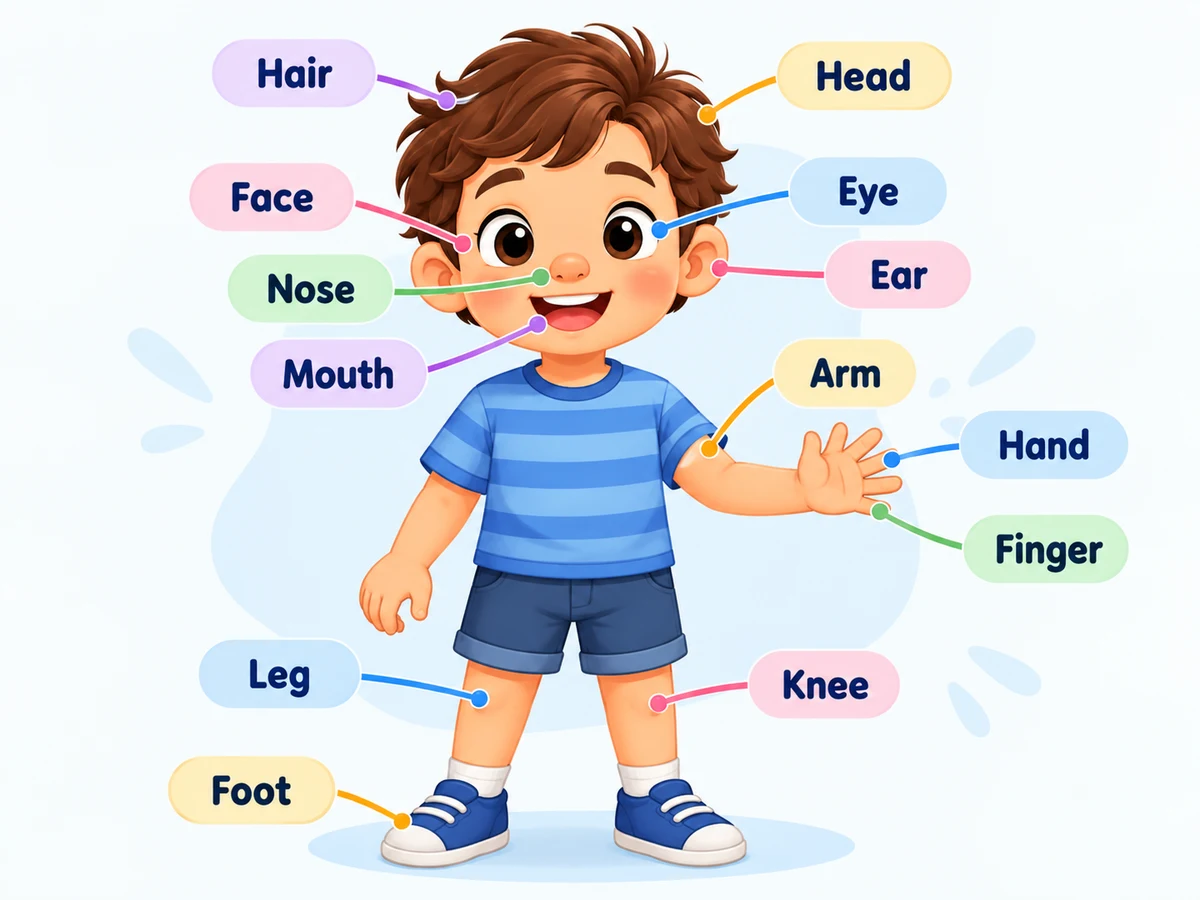
Words such as head, hand and nose come up when children draw people or describe a character. Here you'll find 13 body-part words in English, example phrases and three games using drawings. Your child can join in by looking, pointing or speaking, with no need to touch or move their body.
- Learning language
- English
- Age
- Ages 3–10
- Level
- Beginner

Choose two or three words and point to the matching parts on the illustrated character. Your child can listen, point or say the words with you.
| English | Pronunciation (US IPA) | Simple meaning | Example |
|---|---|---|---|
| head | /hɛd/ | The body part above the neck, with the face at the front. [1] | Here is the head. /hiɹ ɪz ðə hɛd./ |
| hair | /hɛɹ/ | The strands growing on the head, considered together. [1] | Let's draw some hair. /lɛts dɹɔ sʌm hɛɹ./ |
| face | /feɪs/ | The front of the head, where the eyes, nose, and mouth are. [1] | This is a face. /ðɪs ɪz ə feɪs./ |
| eye | /aɪ/ | One of the two organs on the face used for seeing. [1] | Close one eye. /kloʊz wʌn aɪ./ |
| ear | /iɹ/ | A part on either side of the head used for hearing. [1] | Where is the ear? /wɛɹ ɪz ði iɹ?/ |
| nose | /noʊz/ | The part of the face used to smell and breathe. [1] | Touch your nose. /tʌtʃ jɔɹ noʊz./ |
| mouth | /maʊθ/ | The opening below the nose used for eating and speaking. [1] | Here is the mouth. /hiɹ ɪz ðə maʊθ./ |
| hand | /hænd/ | The end part of an arm, including the palm and fingers. [1] | Show me your hand. /ʃoʊ mi jɔɹ hænd./ |
| arm | /ɑɹm/ | The long body part joining a shoulder to a hand. [1] | This is an arm. /ðɪs ɪz æn ɑɹm./ |
| leg | /lɛɡ/ | The long body part joining a foot to the rest of the body. [1] | Point to the leg. /pɔɪnt tə ðə lɛɡ./ |
| foot | /fʊt/ | The part at the end of a leg, used for standing and walking. [1] | Touch your foot. /tʌtʃ jɔɹ fʊt./ |
| finger | /ˈfɪŋɡɚ/ | One of the long, bendable parts of a hand. [1] | Here is a finger. /hiɹ ɪz ə ˈfɪŋɡɚ./ |
| knee | /ni/ | The joint where the upper and lower leg meet and bend. [1] | Where is the knee? /wɛɹ ɪz ðə ni?/ |
Broad US IPA is a reading aid. Listen to the audio for connected speech.
Eye or eyes: Use eye for one and eyes for more than one: one eye, two eyes. See the dictionary entry.
Hand and arm: A hand includes the palm and fingers; an arm connects the shoulder to the hand. Foot and leg: The foot is at the end of the leg, not the whole leg.
Hair: When talking about someone's hair as a whole, normally use hair, not hairs: "The hair is long." A hair means one strand. See the dictionary entry.
Choose from these nine model phrases and reuse a few in any of the games. When practicing on paper, choose "Where is the nose?" or "Point to the nose." Keep all action examples optional.
| English | Pronunciation (US IPA) |
|---|---|
| "Where is the nose?" | /wɛɹ ɪz ðə noʊz?/ |
| "Point to the nose." | /pɔɪnt tə ðə noʊz./ |
| "Here is the nose." | /hiɹ ɪz ðə noʊz./ |
| "This is a hand." | /ðɪs ɪz ə hænd./ |
| "Show me your hand." | /ʃoʊ mi jɔɹ hænd./ |
| "Touch your nose." | /tʌtʃ jɔɹ noʊz./ |
| "Close one eye." | /kloʊz wʌn aɪ./ |
| "Touch your foot." | /tʌtʃ jɔɹ fʊt./ |
| "Let's draw a nose." | /lɛts dɹɔ ə noʊz./ |
Broad US IPA is a reading aid. Listen to the audio for connected speech.
In knee, the written k is silent. In foot and feet, the vowel changes; do not just add an s. The linked American dictionary entries provide pronunciation models.
Say a chosen word, point to its picture, then use it in a short phrase. Your child may repeat or simply listen. Dictionary audio is an optional check for the adult; these games do not need a recording or download.
Play: Body Parts in English for Kids
Keep learning through play — the Nativik app has even more learning games and adventures. Try it!
The British Council recommends short, regular English practice using familiar situations and objects, and naming things in pictures. The games below are our own suggestions, not tested lessons or required steps for a particular age.
1. Be a picture guide
- Goal
- Connect a few spoken body words with parts of a drawing.
- Preparation
- Draw a large person on paper, with a face and clear hands and feet. Add simple marks for hair, fingers, and knees. Choose two or three words, such as head, hand, and nose.
Steps
- Point to each chosen part on the drawing and say its word once.
- Point to the nose and model "Here is the nose." Then ask "Where is the nose?"
- Let your child point, look toward the part, or answer with a word. If they prefer to watch, point and give the answer yourself.
- Change the order and try "Point to the nose." Self-pointing is an option only if the child chooses it; no touching or standing is needed.
- For an optional extra challenge, let the child choose a word for you to find, or try "This is a hand." Finish whenever either of you wants to stop.
- Adult help
- Keep the drawing still and easy to see. When a response is unclear, show the part and say its name rather than treating it as a wrong answer.
- Easier variation
- Use one word. Point and name it yourself while the child watches; no response is required.
2. Direct the drawing
- Goal
- Use the same body words to choose what an adult draws next.
- Preparation
- Take paper and a pencil. Draw a simple example person beside an empty space. Choose head, hand, and nose, or another small selection from the table. The adult can do all the drawing.
Steps
- Point to the chosen parts on the example person and name them. Keep this example visible throughout.
- Start a new person with a head and body outline. Point to a nose and a hand on the example, offering those two choices for what to add.
- Let the child choose by looking, pointing, or saying a word. Name the choice and draw it: "Let's draw a nose." If there is no choice, choose and model it yourself.
- Offer another choice and continue the picture. Reuse the same small word selection; other table words can wait for a different round.
- For an optional extra challenge, let the child direct the order without choices, or request two eyes instead of one. The example can stay in view.
- Adult help
- Make clear, simple marks and supply words when needed. The child does not have to draw, write, count, or remember the picture.
- Easier variation
- Choose just nose. Say "Let's draw a nose," add it yourself, and let the child watch or name it.
3. Move when you hear it
- Goal
- Follow a spoken body or action cue and take turns leading.
- Preparation
- A seated or standing space, or a toy with visible hands and feet.
Steps
- Demonstrate “Clap your hands.” Say it again and allow a gesture or toy movement.
- Add “Show me a foot” or point to the foot on a drawing. Let the child choose how to respond.
- If wanted, demonstrate “Jump,” “Sit down” or “Stand up,” then mix two familiar cues.
- Swap leaders: your child chooses a cue by saying it, pointing to a drawing or demonstrating, and you follow.
- Adult help
- No touching, standing or jumping is required. A look toward a drawing or moving a toy can replace any action.
- Easier variation
- Use one familiar cue and demonstrate every time.
For a song to follow with gestures, try If you’re happy and you know it. The fish story gives foot and shoe a place in a short plot.
Foot or feet? Say one foot and two feet, not "two foots." Feet is the plural of foot.
Hand or arm? Use hand for the part with the palm and fingers, and arm for the part connecting it to the shoulder.
Can we use a drawing? Yes. The drawing games use adult-made drawings. An adult can also point to their own body while the child looks; there is no need for a mirror, printed worksheet, or special toy.
Must children copy all actions? No. The movement sentences are examples of English, not participation rules. Offer looking, pointing, answering, or watching instead. Skip any action the child does not want to do.
The word notes use American dictionary entries; the home-practice context uses British Council guidance. This selection and its examples are editorial choices, not a tested curriculum or a promise of progress. Ages 3-10 describe the intended audience, not a learning timetable.