Clothes in English for kids
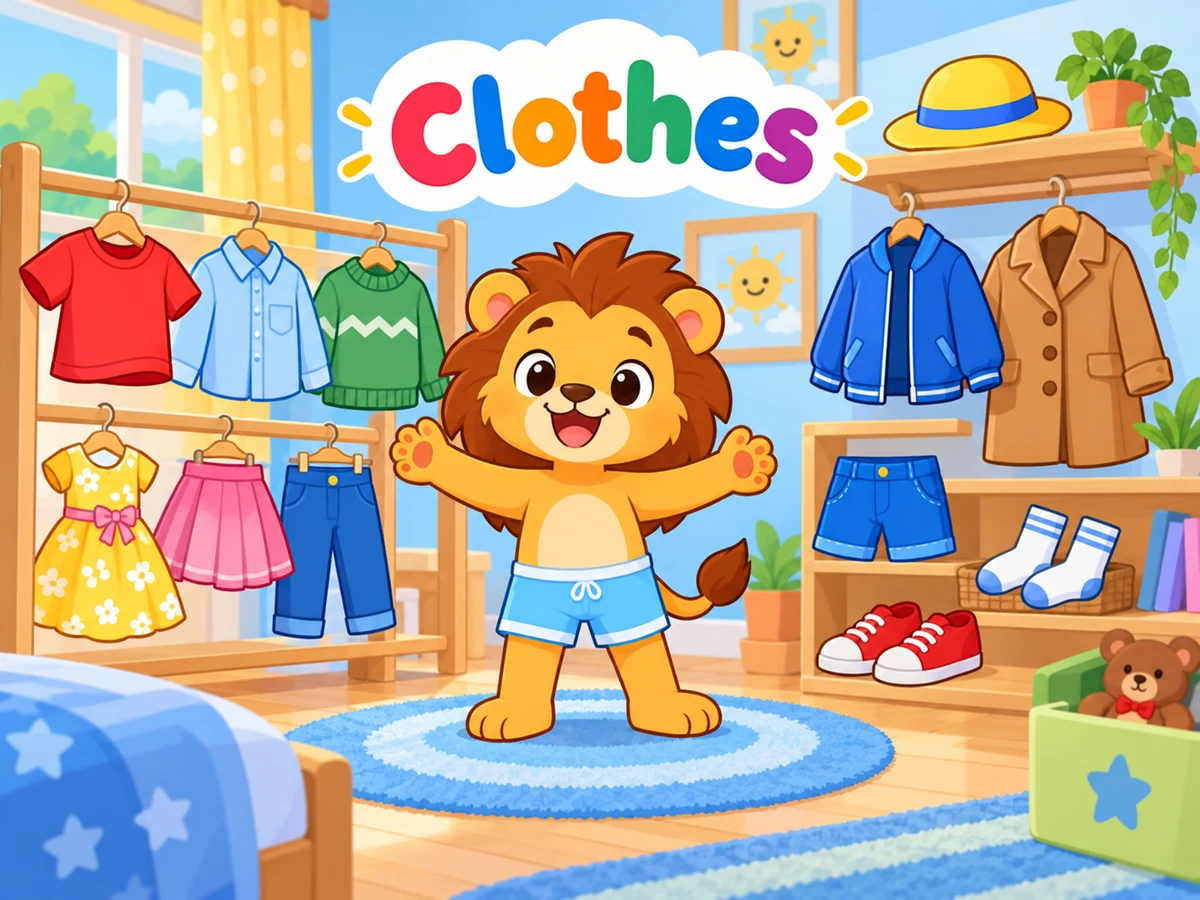
Getting dressed gives you everyday objects to name and describe in English. This guide covers clothing words such as T-shirt, pants and socks, including phrases for one item and for pairs. Two games show how to practice with clothes or simple drawings.
- Learning language
- English
- Age
- Ages 3–10
- Level
- Beginner
For a beginner aged 3-10, choose a few words today and keep the full word list as a reference. Use familiar clothes or draw items your family does not own.
The examples use this is with singular nouns and these are with plural nouns, as explained in the British Council grammar reference. The forms pants and shorts are plural even when you mean one garment.
Choose the lines that fit the clothes in front of you. The person speaking uses my for their own things. With drawings, agree whose pretend clothes they are before starting.
- This is my T-shirt.
- These are my pants.
- This is my shoe.
- These are my shoes.
- Where is my hat?
- Where are my socks?
- Here it is.
- Here they are.
For shoe/shoes, show one shoe for the singular line and two shoes for the plural line. Collins lists both forms.
For an easier turn, let your child point while you speak. For a harder turn, let them ask and you answer. These are choices, not age-based milestones.
T-shirt has two syllables: say the letter name T, then shirt. In sweater and jacket, the first syllable is stressed. The linked T-shirt, sweater and jacket entries give pronunciation guidance.
Point to the item, say its name naturally, then say the whole phrase. Pause for your child to try, or let them listen. Keep it a conversation, not a pronunciation test.
Play: Dress Up
The British Council suggests using familiar objects and daily routines for English practice, including talking about clothes while sorting laundry. The two activities below are original suggestions, not a tested lesson sequence.
Use a clear surface and clean clothes without loose decorations, or large adult-made drawings. Skip hangers, pins and plastic bags. Children can point; no one has to change clothes.
1. Sort the clothes and say whose they are
- Goal
- Match clothes of the same type and try a sentence with this is or these are.
- Preparation
- Choose two or three types from the table, such as T-shirt, pants and socks. Set out two clean examples of each, or make two drawings of each type. Keep each pair of socks together. Use your child's clothes, or agree that the drawings are their pretend clothes.
Steps
- Place one example of each type in a separate space. Mix the remaining items or drawings in the middle.
- Name one mixed-up item and show where it belongs. Invite your child to place the next matching item beside its example.
- Let your child hold or point to their T-shirt. Supply the line for them to try: "This is my T-shirt." For their pants, model "These are my pants."
- Switch jobs: your child names or points to an item, and you sort it. Finish after a few turns, or choose another type together.
- Adult help
- Make clear that you are modeling the child's words when you say my. Use the whole line yourself if they prefer to point. With several examples in a group, indicate just one T-shirt or one pair of pants for the model sentence.
- Easier variation
- Use only two clothing types and sort together, with the adult doing all the naming.
2. Find the missing clothes
- Goal
- Notice which clothing item is missing and practice asking for it.
- Preparation
- Reuse three clothing types from the first game, or choose a hat, a T-shirt and a pair of socks. Use clean items or adult-made drawings. Agree whose real or pretend clothes they are; keep the socks together.
Steps
- Lay out the three choices. Point to each one and say its name together.
- Ask your child to look away while you move one item behind your back. Keep the other two in place.
- Invite them to spot what is missing. When it is their hat, model "Where is my hat?" When it is their socks, model "Where are my socks?" A word or a pointing response is enough.
- Bring it back, saying "Here it is" for the hat or T-shirt, or "Here they are" for the socks. Swap roles for the next turn.
- Adult help
- Supply the question for your child to copy rather than requiring them to invent it. When roles change, agree that the pictures are now the new questioner's pretend clothes. Offer a hint or reveal the item rather than keeping score.
- Easier variation
- Use two drawings and let your child watch you move one away. Name the missing picture yourself, then bring it back.
Pants or trousers? This US-English guide uses pants for the outer garment. British English usually calls it trousers, while pants can mean underwear. British jumper means sweater. These are regional uses, not different learning levels. See pants and jumper.
Shirt or T-shirt? A T-shirt is a kind of shirt. For this practice, use shirt for a button-front top with a collar and T-shirt for the collarless pull-on type. Write T-shirt with a capital T and a hyphen. See shirt and T-shirt.
Why a pair of pants? English treats pants and shorts as plural nouns for garments with two leg sections. Say a pair of pants or a pair of shorts for one garment. Compare "These are my pants" with "This is my pair of pants." A pair of shoes means two shoes used together. See pair.
Can any child use all these words? Use the whole list as a reference, not a requirement to know every word. Do not divide it into boys' words and girls' words. A child can name a dress, skirt, pants or hat without owning or wearing it. Choose familiar items first and use drawings for the rest.
The clothing list is an editorial selection, and the examples and activities are not a tested curriculum. Ages 3-10 describe the intended audience, not a promise of progress. Dictionary text and parent guidance were consulted on October 13, 2026; no audio playback was tested.