Fruits in English for Kids: 12 Names and Two Simple Games
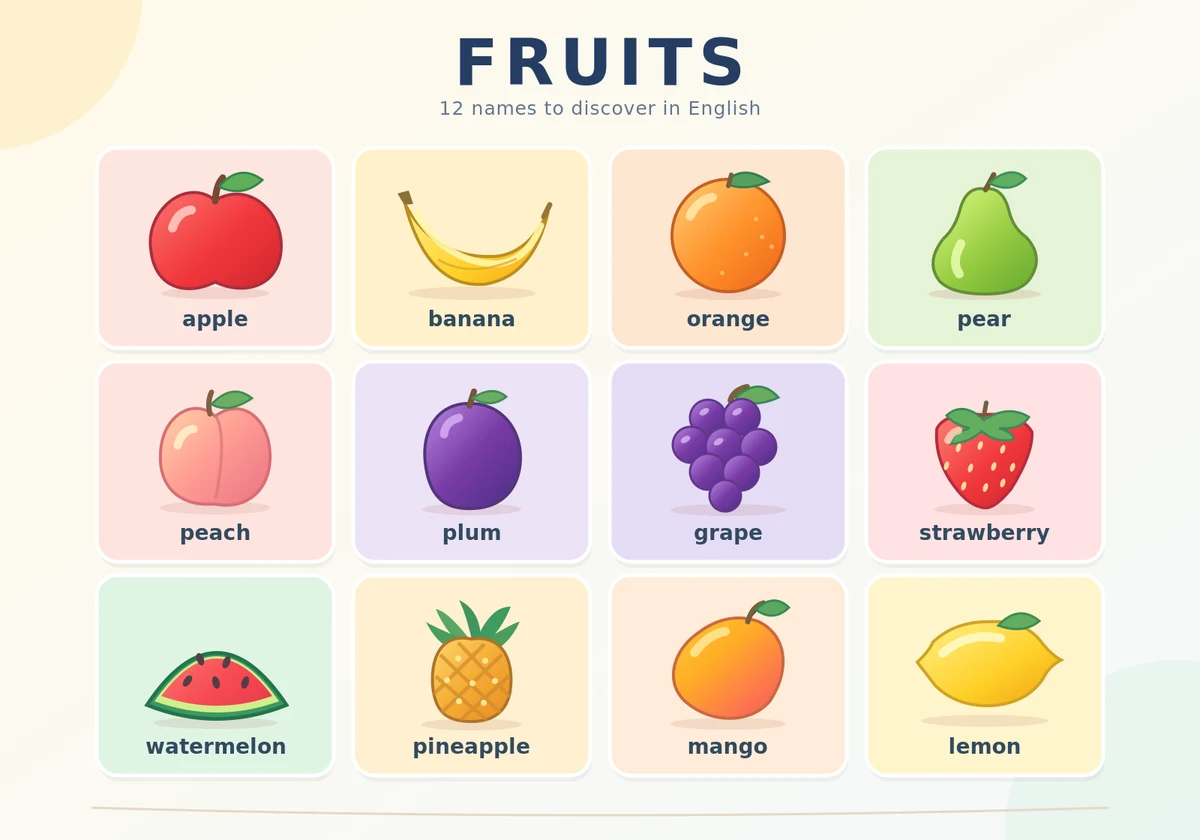
Fruit names can become part of English practice when you talk about a snack, look at a picture or play pretend shop. This page brings together 12 fruit words, short phrases and two games you can adapt to the fruit your child already recognizes.
- Learning language
- English
- Age
- Ages 3–10
- Level
- Beginner
Choose a few familiar fruits and say their names as you point to them. Use real fruit, pictures or the game below.
- apple / apples
- banana / bananas
- orange / oranges
- pear / pears
- peach / peaches
- plum / plums
- grape / grapes
- strawberry / strawberries
- watermelon / watermelons
- pineapple / pineapples
- mango / mangoes or mangos
- lemon / lemons
Notice the spellings peaches and strawberries. For mango, both mangoes and mangos are correct; this guide uses mangoes in its examples. See peach, strawberry, and mango in Collins.
Choose the phrases that fit your game. A pointing response or a single fruit name is welcome; model a longer phrase without requiring your child to repeat it.
- Point to the apple.
- Where is the banana?
- It's an orange.
- Can I have an apple, please?
- Here you go.
- Thank you.
- One apple.
- Two apples.
For one item, use one apple; for more than one, use two apples. Change the fruit name to match your picture: one peach, two peaches; one strawberry, two strawberries. These are examples of singular and plural forms, described in the British Council count-noun guide.
Collins lists these US pronunciations: apple /ˈæpəl/, banana /bəˈnænə/, and mango /ˈmæŋɡoʊ/. Stress the first syllable in apple and mango, and the second syllable in banana. The banana entry also lists UK /bəˈnɑːnə/; this guide uses the US form.
Your child does not need to read these symbols. Say the whole word while showing the picture, pause, and offer another turn. Dictionary pronunciation resources are optional: neither game requires audio, a device, or a download.
Play: Fruit shop
Our fruit-slicing mini-game in Nativik puts fruit into the action. Your child hears the fruit words and then says them as part of the game’s language practice. Afterwards, you can bring that play into snack time: name a fruit in English and invite your child to point to it.
The British Council suggests practicing with familiar objects and everyday situations, keeping activities short and varied, and reusing phrases. The games below are original suggestions, not activities tested by the British Council.
Start with the same few words in both games, such as apple, banana, and orange. Fewer pictures, extra pictures, or longer phrases are choices, not milestones for particular ages. Stop when either of you has had enough.
Game 1: Point and name
- Goal
- Practice connecting a spoken fruit name with the matching object or picture.
- Preparation
- Choose apple, banana, and orange, or another small selection from the table. Use adult-made drawings, clear pictures on packaging, or suitable whole fruits held by the adult. The child only needs to point. No cutting, tasting, or food rewards are involved.
Steps
- Show each item and say its name once: apple, banana, orange. Point as you speak.
- Say "Point to the apple." Pause for a response, then point together if needed.
- Ask "Where is the banana?" Change the positions and repeat with the same words.
- Point to the orange and model "It's an orange." Invite the child to choose the next picture. For more practice, add another familiar fruit from the table.
- Adult help
- Keep real fruit and packaging under adult control; use drawings whenever an object is unsuitable. Show the answer without turning a mistake into a test. Speaking is optional.
- Easier variation
- Show one drawing, say its name, and point together. Add a second only when you both feel like continuing.
Game 2: Fruit picture shop
- Goal
- Use the same fruit names to request and hand over a picture.
- Preparation
- Use adult-made apple, banana, and orange drawings, one on each sheet, or drawings of the words chosen in Game 1. Put them on a table. No real food, play money, or purchased materials are needed.
Steps
- Be the shopper and let your child be the shopkeeper. Ask "Can I have an apple, please?" Point to its drawing if needed.
- Let your child hand you the picture. Model "Here you go" for the handover, without requiring speech.
- Say "Thank you." Return the picture and request a banana or an orange using the same sentence pattern.
- Swap roles when your child wants a turn as shopper. For a harder option, draw two apples on another sheet and request "Can I have two apples, please?"
- Adult help
- Supply the request when needed and respond to a point or single word. Keep the exchange moving instead of withholding the picture until pronunciation is exact.
- Easier variation
- Use one drawing. Say "Apple, please" and help your child pass the picture, then swap roles.
Fruit or fruits? Use fruit for the general category: "I like fruit." Fruits is also correct, including when talking about different kinds: "Mangoes and pineapples are tropical fruits." To count individual items, name them: "two apples." Collins records both fruit and fruits.
Apple or an apple? Apple works as a picture label or a short answer. In a sentence about one item, say "I have an apple," not "I have apple." Use an before a vowel sound, as in an apple and an orange; use a before a consonant sound, as in a banana. See the British Council guidance on articles and count nouns.
Can we use drawings? Yes. Draw one recognizable fruit on each sheet, point to it, and say the name. Use the same drawings for both games. A printer, polished artwork, and real fruit are unnecessary.
What if these fruits are unavailable locally? Begin with familiar words from the word list. Draw the others or leave them for another day. There is no need to buy unfamiliar produce or work through every entry.
The vocabulary list is an editorial choice. These examples and games are not a tested curriculum, and the intended ages are not promises about development or progress. Dictionaries support the language notes; British Council guidance supports the general practice suggestions, not a required number of words or guaranteed results.