Food and drinks in English for kids
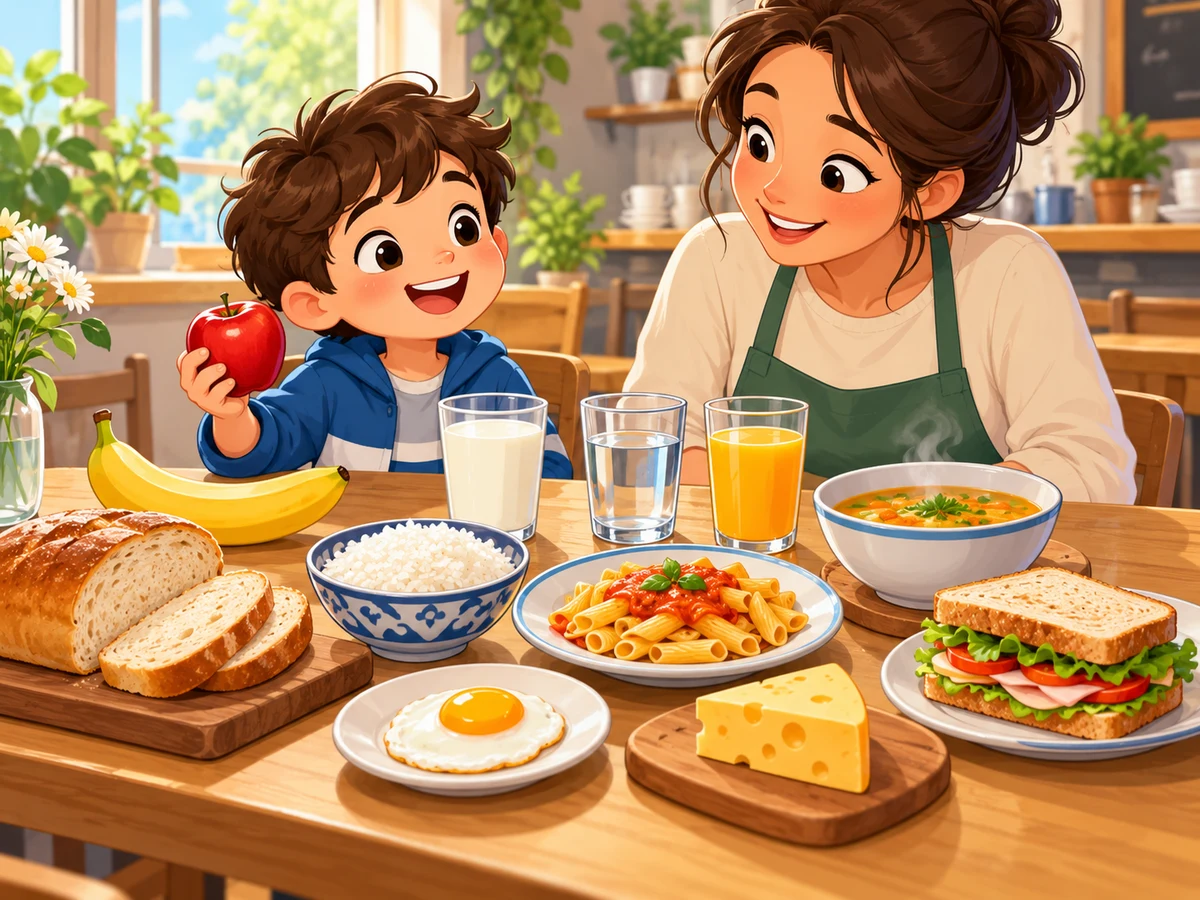
Food and drink words help children name familiar things and make simple requests in English. This guide combines everyday vocabulary with phrases for offering and choosing food, followed by two pretend-play games. You can use pictures and let your child choose how to respond.
- Learning language
- English
- Age
- Ages 3–10
- Level
- Beginner
Choose two or three words your child recognizes from home for the first game. That is a starting suggestion, not a target. Keep the rest of the table as a reference rather than a one-session memory test.
Here, milk means dairy milk, such as cow's milk, used as a drink or an ingredient. See the milk entry.
Your family can choose water or another familiar drink in the games. The examples describe English, not what your child should consume.
When counting whole items, say an apple / two apples, an egg / two eggs, and a sandwich / two sandwiches. With milk, bread, rice, and water, use some in these everyday examples: some milk, some bread, some rice, some water. See British Council grammar guidance.
To count bread portions, say a slice of bread or two slices of bread. You are counting the slices. See the bread entry.
Try these nine phrases. Reuse just a few in each game, and accept a gesture instead of a spoken reply.
- Would you like an apple?
- Would you like some water?
- Yes, please.
- No, thank you.
- Here you go.
- Thank you.
- Can I have some bread, please?
- Show me the apple.
- I have a sandwich.
For offers and requests, some is natural with food or drink amounts: "Would you like some water?" and "Can I have some bread, please?" See the explanation of some in questions.
Bread /bred/ and rice /raɪs/ each have one syllable. Cheese /tʃiːz/ ends with a /z/ sound. These forms work for US English; see Oxford's entries for bread, rice, and cheese.
The symbols are an adult reference, not something your child needs to read. Model the whole word, point to its picture, then use it in a line such as "I like bread." Let your child listen or point instead of repeating.
Play: Food and drinks
Food and drinks appear in several scenes in Nativik, with the same language sequence throughout: your child hears a word, then says it. After playing, look for a familiar food or drink at home and name it together. The words on this page can help you add a short phrase such as "I like..." to that conversation.
The British Council's home-learning guidance recommends short, recurring practice and familiar objects and situations. The games below are editorial suggestions, not activities tested by the British Council.
1. The pretend snack counter
- Goal
- Name food or drink and accept or decline a pretend offer.
- Preparation
- Start with apple, bread, and water. An adult draws each on a separate sheet or selects intact, empty packaging without loose parts or sharp edges. Use drawings for liquids, eggs, and loose grains.
Steps
- Point to each picture or package and name it. Make clear that this is pretend play: nothing will be eaten, opened, or poured.
- Hold up the apple picture and ask, "Would you like an apple?" Pause for a reply, a nod, a point, or a shake of the head.
- For yes, hand over the picture and say, "Here you go." Offer "Thank you" as an optional reply. For no, accept the choice and put the picture down without asking again.
- Try another picture: "Would you like some water?" Model "Yes, please" and "No, thank you" without choosing the child's answer.
- Adult help
- Supply a phrase when needed, then wait. A child may choose neither picture or end the game. Do not make receiving a picture depend on perfect speech.
- Easier variation
- Use two pictures and make one offer. Let your child point or shake their head while you supply the words.
For a harder version, swap roles so your child makes an offer, or let them request a picture with "Can I have some bread, please?" This is an optional variation, not an age milestone.
2. Food-or-drink delivery
- Goal
- Match a spoken word to a picture and place it in a food or drink group.
- Preparation
- Reuse the same small set of pictures. An adult draws two large circles on paper, one for food and one for drinks, and points out which is which. Your child does not need to read labels.
Steps
- Spread out the pictures and name them together. Put the apple picture by the food circle and the water picture by the drink circle to demonstrate.
- Return the pictures to the middle. Say, "Show me the apple." Let your child select it and deliver it to the food circle.
- Repeat with another picture, replacing apple in the request with its name. Use the food or drink label in the table as your guide.
- Name each delivered picture once more. For an optional challenge, add one other table word or let your child give the adult a delivery request.
- Adult help
- Point to the destination when needed. If a picture is unclear, redraw it or replace it; do not treat guessing your drawing as a language test.
- Easier variation
- Use only the apple and water pictures. Name one, point to its circle, and let your child move it with your help.
Food or foods? Use food for eating in general: "There is food on the table." Foods can mean different types: "We drew three different foods." See the food entry.
A bread or some bread? In this everyday meaning, say some bread, a slice of bread, or a loaf of bread, not a bread for one slice. See the bread entry.
Must we taste the food? No. Both games work with drawings or suitable empty packaging. Your child can decline, listen, point, or stop. Eating and drinking are never required.
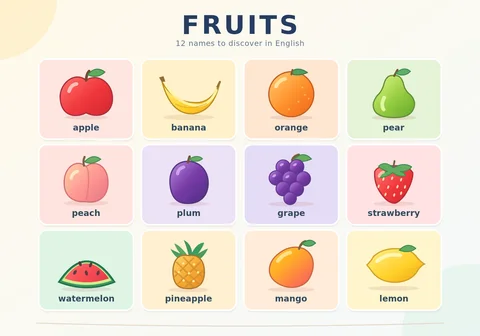
How is this different from fruit vocabulary? Apple and banana are fruit words within this wider set. Here, you also name bread, rice, soup, and drinks. A fruit-focused activity would explore more fruit names rather than this mix of food and drink.
This vocabulary list is an editorial choice, and the examples and games are not a tested curriculum. Ages 3-10 describe the intended audience, not developmental milestones or promised results.