Daily routine in English: words for your child's day
Wake up, get dressed, have breakfast and go to bed are useful daily routine phrases in English. Use the present simple for things you do regularly: "I have breakfast." Add first and then to describe a short sequence that fits a real or fictional day.
- Learning language
- English
- Level
- beginner
Two families may describe quite different days. Your English activity can follow your own day, or a paper character's imaginary one. The aim is to give familiar actions English names; you can change the order, skip an action or use a different example whenever it fits better.
| English | Pronunciation (US IPA) | Meaning or use | Example |
|---|---|---|---|
| wake up | /weɪk ʌp/ | Stop sleeping. | I wake up. /aɪ weɪk ʌp./ |
| get up | /ɡɛt ʌp/ | Get out of bed. | I get up in the morning. /aɪ ɡɛt ʌp ɪn ðə ˈmɔɹnɪŋ./ |
| get dressed | /ɡɛt dɹɛst/ | Put clothes on. | I get dressed. /aɪ ɡɛt dɹɛst./ |
| have breakfast | /hæv ˈbɹɛkfəst/ | Eat the meal called breakfast. | I have breakfast. /aɪ hæv ˈbɹɛkfəst./ |
| go to school | /ɡoʊ tə skul/ | Travel to or attend school. | I go to school. /aɪ ɡoʊ tə skul./ |
| play | /pleɪ/ | Spend time in play. | I play at home. /aɪ pleɪ æt hoʊm./ |
| read | /ɹid/ | Look at written words and understand them. | I read a book. /aɪ ɹid ə bʊk./ |
| have dinner | /hæv ˈdɪnɚ/ | Eat the meal called dinner. | I have dinner with my family. /aɪ hæv ˈdɪnɚ wɪð maɪ ˈfæməli./ |
| go home | /ɡoʊ hoʊm/ | Return to the place where you live. | I go home. /aɪ ɡoʊ hoʊm./ |
| go to bed | /ɡoʊ tə bɛd/ | Get into bed for sleep or rest. | I go to bed. /aɪ ɡoʊ tə bɛd./ |
Broad US IPA is a reading aid. Listen to the audio for connected speech.
Wake up and get up describe different actions. A character can wake up and stay in bed before getting up. Keep each phrase beside a different drawing so your child can see what you mean.
| English | Pronunciation (US IPA) |
|---|---|
| What do you do in the morning? | /wʌt du ju du ɪn ðə ˈmɔɹnɪŋ?/ |
| I get dressed. | /aɪ ɡɛt dɹɛst./ |
| First, I have breakfast. Then, I play. | /fɝst, aɪ hæv ˈbɹɛkfəst. ðɛn, aɪ pleɪ./ |
| I read a book in the evening. | /aɪ ɹid ə bʊk ɪn ði ˈivnɪŋ./ |
| What comes next? | /wʌt kʌmz nɛkst?/ |
| Now it's your turn. | /naʊ ɪts jɔɹ tɝn./ |
Broad US IPA is a reading aid. Listen to the audio for connected speech.
The present simple is useful for regular actions: "I play" and "We read". With she or he, the verb usually changes: "She plays" and "He reads". Start with I if the extra change distracts from the action words. British Council: present simple.
Use in the morning and in the evening. At night is the common phrase for that part of the day. You can leave time phrases out until the action is familiar. British Council: time and dates.
Routine has its main stress on the second syllable in Cambridge's /ruːˈtiːn/ form. Check the routine entry. Your child can practise the shorter action phrases without needing to say the topic heading.
Say get up or get dressed as a phrase while moving a paper character. Model the phrase again inside "I get dressed." The written words do not show all the changes heard in connected speech, so use a dictionary model for unfamiliar words.
- [Days of the week in English for kids](/learn/days-of-the-week/)
- [Food and drinks in English for kids](/learn/food/)
- [Clothes in English for kids](/learn/clothes/)
Play: Daily routine in English: words for your child's day
Keep learning through play — the Nativik app has even more learning games and adventures. Try it!
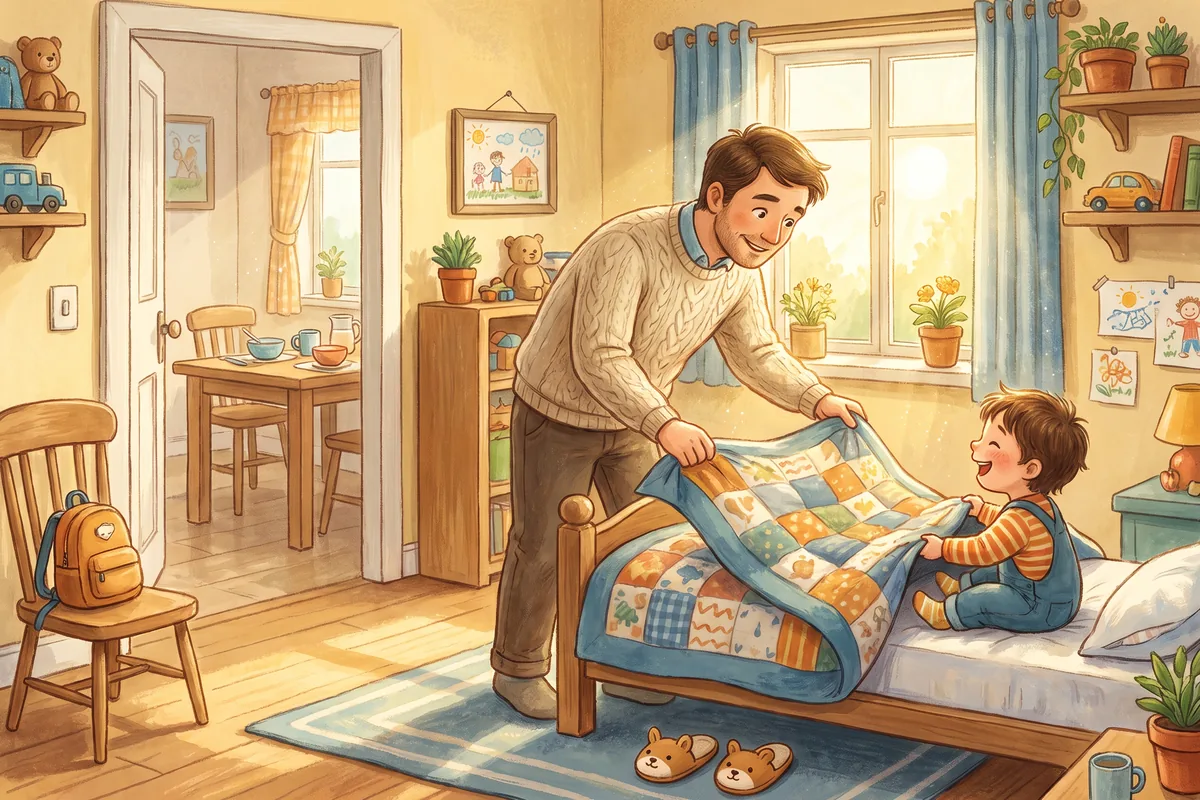
Our home scene has a kitchen and a bed, and the character can be seen asleep in the bed. Use those places to make a pretend day together: point to the kitchen for "I have breakfast" and to the bed for "I go to bed." After playing, arrange your own morning and evening pictures in order. The sequence and sentences are an activity you supply.
Prepare only the actions you want for today's activity. Real routines can stay in your usual language. If you use a fictional character, your child can invent its day without sharing family schedules or personal details.
A day in four pictures
- Goal
- Describe a short sequence.
- Preparation
- Draw four chosen actions from the list.
Steps
- Arrange two actions and say, "First, I get up. Then, I have breakfast."
- Invite your child to change or add a picture.
- Describe the chosen order. Ask "What comes next?" and let a point be the answer.
- Adult help
- Use a possible sequence for your family or make clear that it is a character's story. There is no required order for the whole set.
- Easier variation
- Use two pictures without first and then.
The paper character's unusual day
- Goal
- Connect action phrases with meaning.
- Preparation
- Draw a character and keep the action pictures nearby.
Steps
- Give the character a pretend day: it reads before breakfast, for example.
- Let your child move the next action into the story.
- Say the matching phrase in the character's voice: "I read a book." Continue only while the child wants to add actions.
- Adult help
- Treat unusual choices as story choices. Do not use the game to correct a child's real routine.
- Easier variation
- Let the character perform one action.
An action mime menu
- Goal
- Recognise a phrase without reading.
- Preparation
- Choose two or three action drawings; stay seated if preferred.
Steps
- Mime a small action, such as opening a book, and say "read".
- Ask your child to point to its drawing, choose another mime or say the phrase.
- Swap roles: the child can show a picture while you mime and name it.
- Adult help
- All movement is optional. Picture selection or moving the paper character works too.
- Easier variation
- Show the picture before doing the mime.
Do we need clock times? No. Action names and first/then are enough for these activities. Add a time only when it gives your sentence useful information.
What if our child learns at home? Replace go to school with an action that fits, or use it only for a fictional character. The word list does not prescribe a family's education or daily schedule.
Are wake up and go to bed opposites? They concern different moments: wake up means stop sleeping; go to bed means get into bed. Going to bed does not necessarily mean falling asleep immediately.