Days of the week in English for kids
Monday, Tuesday, Wednesday, Thursday, Friday, Saturday and Sunday are the seven days of the week in English. This guide connects the names with familiar routines, explains spelling and pronunciation, and offers two games for talking about the days together.
- Learning language
- English
- Age
- Ages 3–10
- Level
- Beginner
The seven days of the week in English are Monday, Tuesday, Wednesday, Thursday, Friday, Saturday, and Sunday. Begin with today's name and the next day, then try the two games below.
For a pretend week, try Monday, Tuesday, and Wednesday first. The full word list is a reference, not a list your child needs to memorize in one sitting.
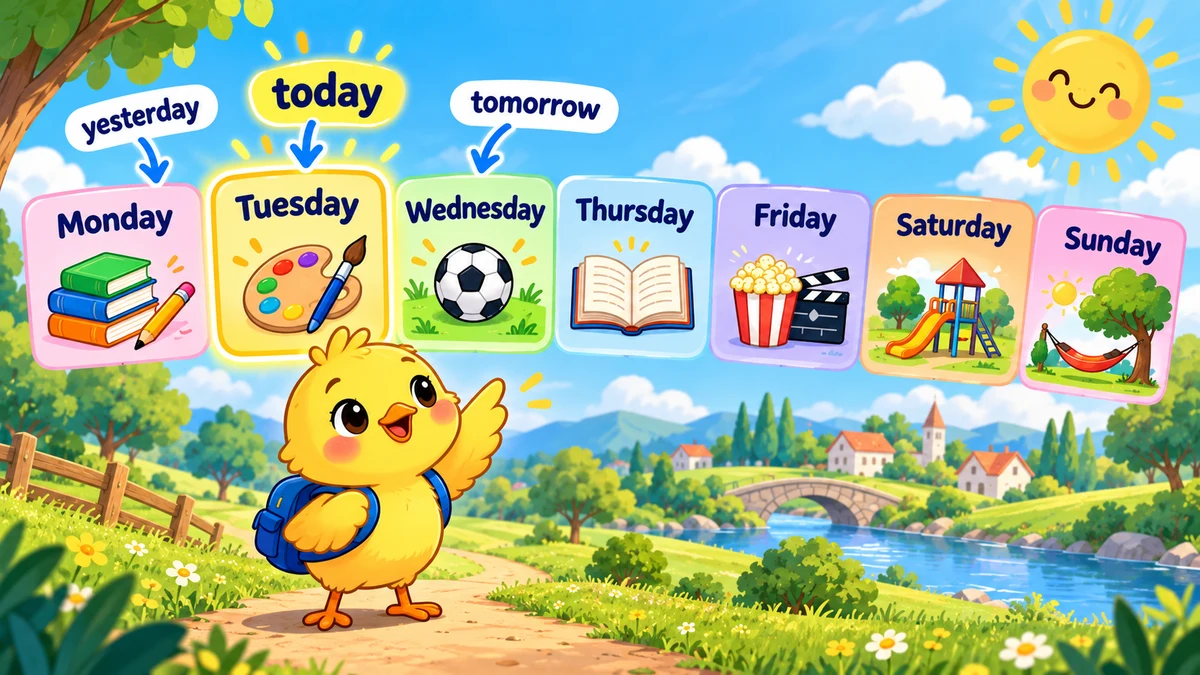
The seven day names run from Monday to Sunday. Today, tomorrow and yesterday describe a day in relation to the present day.
Some US calendars start with Sunday; Unicode's US calendar data uses that convention. This guide starts with Monday, but Sunday still comes before Monday in the repeating sequence.
A day name is not a month name or a numbered calendar date: Monday names a day in the weekly pattern, while July 8 identifies a day within a month. The British Council time guide treats days, dates, and months separately. These games focus on day names.
For this model conversation, pretend today is Tuesday: drawing was on Monday, reading is today, and singing is tomorrow. Swap in the real day names when you stop pretending.
- What day is it today?
- Today is Tuesday.
- What day is tomorrow?
- Tomorrow is Wednesday.
- What day was yesterday?
- Yesterday was Monday.
- We draw on Monday.
- We read today.
- Let's sing tomorrow.
Use on Monday, not in Monday, when naming the day something happens. In ordinary time expressions with today, tomorrow, or yesterday, leave out on: “We read today.” “Today is Tuesday” identifies the day without a preposition. See the British Council time guide.
Collins' American English entry for Wednesday shows two syllables, with stress on the first. Model the complete name rather than trying to give every written letter a separate sound. Use the American pronunciation section for this US-focused guide; the British section is labeled separately.
Say one name, point, and pause. Let your child listen, point, or join in. Dictionary links are optional adult references; the games need no recording, pronunciation respelling, or independent reading by the child.
Play: Week hopper
The British Council's parent guidance suggests short, familiar routines and practice with household objects. The games below are original suggestions, not activities tested by that organization. Choose a simpler or harder turn to suit your child; these choices are not age-based milestones.
1. A pretend week in seven boxes
- Goal
- Connect day names with today, tomorrow, and yesterday by pointing to a simple plan.
- Preparation
- An adult draws seven boxes on paper and labels them Monday through Sunday. Add a crayon picture for drawing on Monday, Thursday, and Sunday; a book for reading on Tuesday and Friday; and a singing face for Wednesday and Saturday. No printed calendar is needed.
Steps
- Explain that this is a pretend week, not the real date. Point to Monday, Tuesday, and Wednesday and say their names.
- Keep your finger on Tuesday. Say “Today is Tuesday.” Ask “What day is it today?” Your child can point or answer.
- Keep Tuesday marked while your child points to Wednesday: “Tomorrow is Wednesday.” Then point back to Monday: “Yesterday was Monday.”
- Point to Tuesday's book: “We read today.” Point to Wednesday's singing face: “Let's sing tomorrow.” Invite your child to choose the matching picture.
- For a harder turn, pretend today is Sunday. Show Saturday as yesterday, then move from Sunday back to Monday for tomorrow. Keep saying that these are pretend changes.
- Adult help
- Read every label aloud; do not require spelling. Pause after each prompt and accept pointing. Return to the Tuesday example whenever you need a fresh start.
- Easier variation
- Show only Tuesday and Wednesday. Model today and tomorrow while the child points. Leave yesterday and the longer sequence for another turn.
2. The picture clue game
- Goal
- Match a spoken day name to a pretend activity instead of reciting the week in order.
- Preparation
- Draw three large pictures: a crayon, an open book, and a singing face. Beside the crayon write Monday, Thursday, Sunday; beside the book write Tuesday, Friday; beside the face write Wednesday, Saturday. This is an invented plan, not a school schedule.
Steps
- Point to each picture and read its day labels. Model “We draw on Monday” while pointing to the crayon.
- Choose days out of order. Say “We sing on Saturday” or “We read on Friday.” Let your child choose the matching picture.
- Pretend today is Tuesday. Say “We read today,” then “Tomorrow is Wednesday,” then “Yesterday was Monday.” Help your child point to the book, singing face, and crayon in that order.
- Swap roles: your child points to a day label, and you read it aloud. Choose the wrong picture deliberately and let the child correct your choice.
- For a harder turn, cover the written labels with your hand. Offer one day name and invite a picture choice or a sentence about that day.
- Adult help
- Read labels and model the actions if needed. Keep the pictures visible unless your child chooses the harder turn; this is shared play, not a memory test.
- Easier variation
- Start with only Monday and its crayon, and Tuesday and its book. Give the day name and point together before adding other days.
Why do day names start with capital letters? English writing uses capitals for the names of days, even in the middle of a sentence: “We read on Tuesday.” Purdue OWL lists this convention. Write today, tomorrow, and yesterday in lowercase unless a sentence position requires a capital.
Should Monday or Sunday come first? Both layouts are used. Our practice word list starts Monday; some US calendars start Sunday. The Unicode locale data records different first-day conventions. Whichever box comes first on paper, Monday follows Sunday.
Is it on Monday or in Monday? Use “on Monday”: “We draw on Monday.” Do not replace on with in. “Today is Tuesday” needs neither. The British Council time guide explains these patterns.
What if our weekend or school days are different? Use your own routine. Weekend conventions vary by region; a family's school and rest days need not match this pretend plan. When you switch to real-life practice, replace the pictures to fit your actual schedule.
Dictionary entries support word meanings and pronunciation; grammar guidance supports usage. The vocabulary grouping and games are editorial choices, not a tested curriculum or a promise of progress. Ages 3-10 describe the intended audience, not developmental expectations.