Places in the city in English: words and paper-map activities
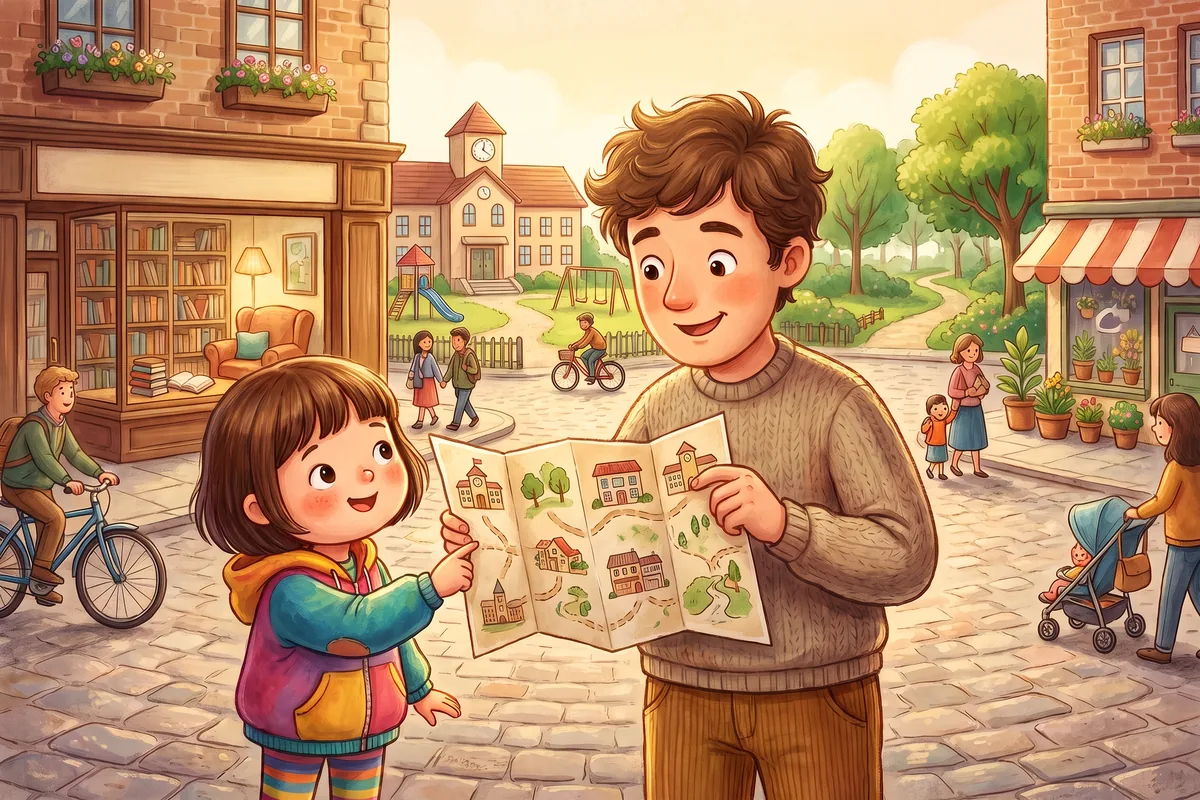
Park, school, library, hospital and supermarket are useful place names in English. Ask "Where is the library?" and answer with a simple location: "It's next to the park." A pretend map lets children practise the words without navigating a real street.
- Learning language
- English
- Level
- beginner
A familiar building can be a useful starting point for city vocabulary. Your child may recognise a library, a café or the place a train stops. You can put those places on a paper map and practise asking where something is, even if your family lives outside a city.
| English | Pronunciation (US IPA) | Meaning or use | Example |
|---|---|---|---|
| park | /pɑɹk/ | An open area people can visit for recreation. | The park is next to the library. /ðə pɑɹk ɪz nɛkst tə ðə ˈlaɪbɹɛɹi./ |
| school | /skul/ | A place where people go to learn. | The school is on the map. /ðə skul ɪz ɑn ðə mæp./ |
| library | /ˈlaɪbɹɛɹi/ | A place with books and other materials to read or borrow. | Let's go to the library. /lɛts ɡoʊ tə ðə ˈlaɪbɹɛɹi./ |
| hospital | /ˈhɑspɪtəl/ | A place where people receive medical care. | The hospital is on the map. /ðə ˈhɑspɪtəl ɪz ɑn ðə mæp./ |
| supermarket | /ˈsupɚmɑɹkɪt/ | A shop that sells food and other everyday goods. | The supermarket is next to the café. /ðə ˈsupɚmɑɹkɪt ɪz nɛkst tə ðə kæˈfeɪ./ |
| café | /kæˈfeɪ/ | A place to buy drinks and usually some food. | The café is near the park. /ðə kæˈfeɪ ɪz nɪɹ ðə pɑɹk./ |
| street | /stɹit/ | A public road in a town or city, often with buildings along it. | This is a quiet street. /ðɪs ɪz ə ˈkwaɪət stɹit./ |
| station | /ˈsteɪʃən/ | Here, a place where trains stop for passengers. | The train is at the station. /ðə tɹeɪn ɪz æt ðə ˈsteɪʃən./ |
Broad US IPA is a reading aid. Listen to the audio for connected speech.
Station has more than one meaning. This map uses a train station, with a train or tracks as a clue. Use bus station or police station if that is the place you mean; the extra word changes the meaning.
| English | Pronunciation (US IPA) |
|---|---|
| Where is the library? | /wɛɹ ɪz ðə ˈlaɪbɹɛɹi?/ |
| It's next to the park. | /ɪts nɛkst tə ðə pɑɹk./ |
| The café is near the school. | /ðə kæˈfeɪ ɪz nɪɹ ðə skul./ |
| Let's go to the supermarket. | /lɛts ɡoʊ tə ðə ˈsupɚmɑɹkɪt./ |
| Here is the station. | /hiɹ ɪz ðə ˈsteɪʃən./ |
| Can you find the hospital? | /kæn ju faɪnd ðə ˈhɑspɪtəl?/ |
Broad US IPA is a reading aid. Listen to the audio for connected speech.
Use next to when two places are beside each other on the map. Near means close by and is less specific. Point as you say the phrase, then let your child put two drawings next to each other and name them.
City begins with an /s/ sound, even though it is written with c. Cambridge lists two-syllable UK and US forms, with some difference in the middle consonant. Check the city entry and use one model consistently during the activity.
Model the place name while pointing to its symbol, then add a phrase such as "the library" or "near the park". A child can answer by placing a picture. Written hints are approximate; use a dictionary model for an unfamiliar word.
- [Colors in English for Kids: Words and Two Simple Games](/learn/colors/)
- [Numbers in English for Kids: 0–20](/learn/numbers/)
- [Family members in English for kids: words and games](/learn/family/)
Play: Places in the city in English: words and paper-map activities
Keep learning through play — the Nativik app has even more learning games and adventures. Try it!
Nativik's city scene shows a street with traffic passing the shopfronts, including a toy shop. While you explore together, point to the street and say "This is a street." You can then draw a toy shop on your pretend map and ask where to put it. Add other places from the vocabulary list as you build your own town.
Make an invented map so you can move buildings freely. A few squares and a line for a street are enough. Keep the language task on paper; a real route, address or travel decision is unnecessary.
Build a small map
- Goal
- Name places and arrange them.
- Preparation
- Draw a street and make pictures of a park, library and supermarket.
Steps
- Place the park and name it.
- Ask your child where the library should go. Describe the chosen location.
- Add the supermarket and take a finger tour, saying each place name.
- Adult help
- Use landmarks that make sense to the child. The map can show a village, neighbourhood or imagined city.
- Easier variation
- Use two place pictures.
Where did the café go?
- Goal
- Practise a question and location answer.
- Preparation
- Add a café picture to the paper map.
Steps
- Ask, "Where is the café?" Point and answer, "It's near the park."
- Let your child move the café to a new position.
- Ask again and describe the new place. Swap who asks and who points.
- Adult help
- Use a location phrase that matches the drawing. Avoid asking for left and right before the child wants to use those words.
- Easier variation
- Ask "Where is the café?" and accept a point.
A postcard from our map
- Goal
- Use a place name in a short message.
- Preparation
- Fold a sheet into a pretend postcard; keep the map nearby.
Steps
- Choose a place on the map and draw it on the card.
- Model "Let's go to the library" or another chosen place.
- Let your child pick the next destination and describe it. Move a paper person there on the map.
- Adult help
- Keep the message fictional. Do not include a real home address or ask the child to plan an independent trip.
- Easier variation
- Draw and name one destination.
Can we use this if we live in a village? Yes. Use the places your child knows and add fictional ones when useful. City is the topic heading, not a requirement about where you live.
Do we need to teach directions too? Start with place names and one relation, such as next to. Add direction words later when you have a clear map and a reason to use them.
Should we use café or cafe? Both spellings occur in English. This guide uses café; keep a learner's spelling visible when making your labels.