Toys in English: words for playing together
Ball, doll, teddy bear and toy car are useful toy words in English. Pair a few names with "Can I have...?", "Here you are" and "Let's play." The activities below work with toys you already use or with simple pictures.
- Learning language
- English
- Level
- beginner

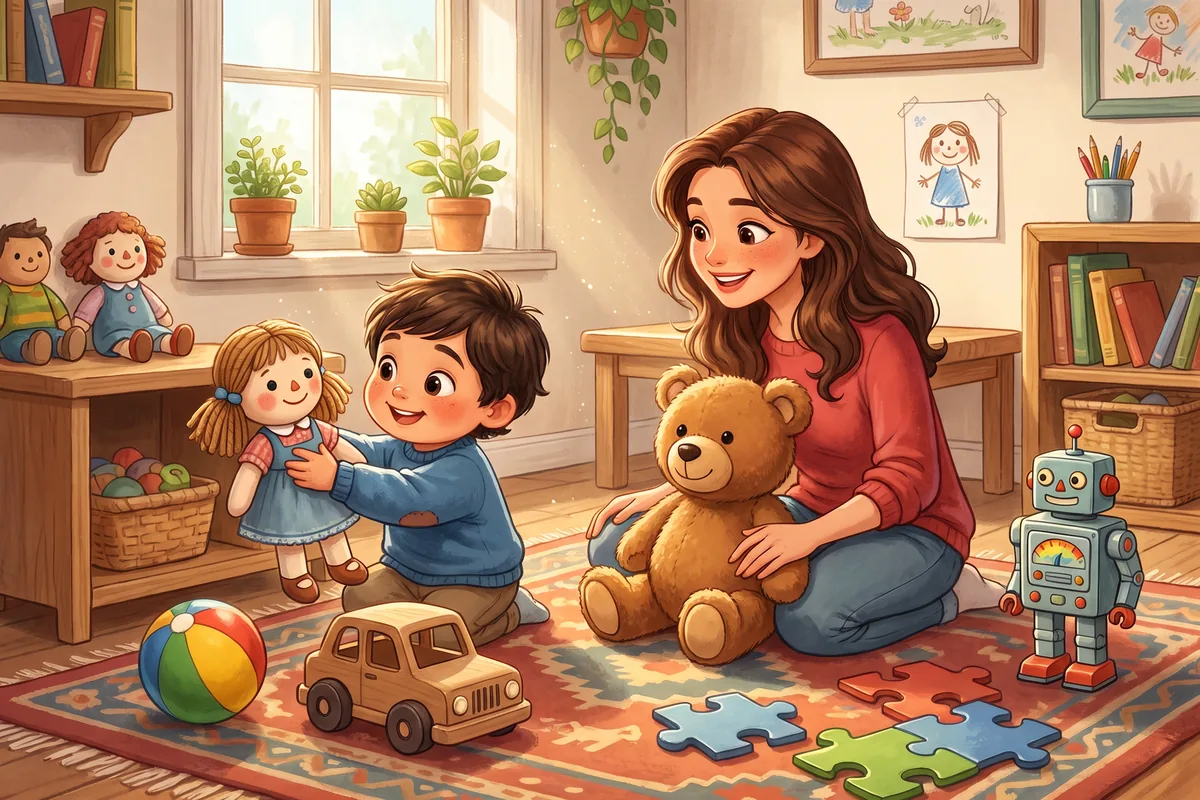
A favourite toy gives an English word something concrete to refer to. You can ask for a ball, move a toy car or help a teddy bear choose a toy. Use the child's interests to decide which names to practise; there is no need to buy a matching set.
| English | Pronunciation (US IPA) | Meaning or use | Example |
|---|---|---|---|
| ball | /bɔl/ | A round object used in games. | I have a ball. /aɪ hæv ə bɔl./ |
| doll | /dɑl/ | A toy made to look like a person. | This is my doll. /ðɪs ɪz maɪ dɑl./ |
| teddy bear | /ˈtɛdi bɛɹ/ | A soft toy bear. | The teddy bear is on the bed. /ðə ˈtɛdi bɛɹ ɪz ɑn ðə bɛd./ |
| robot | /ˈɹoʊbɑt/ | Here, a toy robot. | My robot can move. /maɪ ˈɹoʊbɑt kæn muv./ |
| kite | /kaɪt/ | An object designed to fly on a string. | The kite is in the sky. /ðə kaɪt ɪz ɪn ðə skaɪ./ |
| toy car | /tɔɪ kɑɹ/ | A small car made for play. | The toy car is in the box. /ðə tɔɪ kɑɹ ɪz ɪn ðə bɑks./ |
| train | /tɹeɪn/ | Here, a toy version of a railway train. | Let's play with the train. /lɛts pleɪ wɪð ðə tɹeɪn./ |
| puzzle | /ˈpʌzəl/ | Here, a picture puzzle with pieces that fit together. | Let's do the puzzle. /lɛts du ðə ˈpʌzəl./ |
Broad US IPA is a reading aid. Listen to the audio for connected speech.
| English | Pronunciation (US IPA) |
|---|---|
| Can I have the ball, please? | /kæn aɪ hæv ðə bɔl, pliz?/ |
| Here you are. | /hiɹ ju ɑɹ./ |
| Thank you. | /θæŋk ju./ |
| Let's play with the train. | /lɛts pleɪ wɪð ðə tɹeɪn./ |
| Where is the teddy bear? | /wɛɹ ɪz ðə ˈtɛdi bɛɹ?/ |
| The toy car is in the box. | /ðə tɔɪ kɑɹ ɪz ɪn ðə bɑks./ |
Broad US IPA is a reading aid. Listen to the audio for connected speech.
Use play with for an object: "play with the train". For the picture puzzle, a useful phrase is "do a puzzle". Model each as a whole phrase and let a single toy name be enough for a first reply.
Toy has one syllable in the UK and US forms /tɔɪ/ shown in the Cambridge toy entry. Say it as one unit, then add car: "toy car".
Point to the actual toy or its drawing each time you model a new name. Check unfamiliar names in a learner's dictionary before play. Written sound reminders are approximate and cannot replace listening to a pronunciation model.
- [Colors in English for Kids: Words and Two Simple Games](/learn/colors/)
- [Numbers in English for Kids: 0–20](/learn/numbers/)
- [How to Help Your Child Learn a Language When You Do Not Speak It Well](/en/guides/help-child-learn-language-when-parent-does-not-speak-it/)
Play: Toys in English: words for playing together
Keep learning through play — the Nativik app has even more learning games and adventures. Try it!
Toys appear in Nativik's toy-shop scene. Look around together and let your child choose a toy to talk about. Supply its English name, then try "Can I have it, please?" and "Here you are" as a pretend exchange between you. Afterwards, use a real toy or drawing for another turn.
Use intact toys already suitable for your child, or draw the whole set. Let your child keep a favourite toy nearby; the language game does not depend on handing it over. Explain turn-taking in your home language if needed.
A toy borrowing desk
- Goal
- Practise asking and responding.
- Preparation
- Place two available toys or drawings on the table.
Steps
- Choose one yourself and model, "Can I have the ball, please?"
- Offer your child a turn to choose by pointing or using a word. Supply the request if helpful.
- Pass the chosen toy only if it is available for the game. Say, "Here you are", and model "Thank you".
- Adult help
- A child can decline to lend a toy. Use spare toys or pictures so nobody must give up something special.
- Easier variation
- Offer two drawings and name the chosen one.
One toy goes missing
- Goal
- Recall a toy name.
- Preparation
- Set out three large toy pictures and a sheet of paper.
Steps
- Name ball, doll and train together.
- Ask your child to look away if they want to; cover one picture.
- Ask, "Where is the train?" Let the child uncover the picture and say its name with you. Swap roles.
- Adult help
- Keep it playful. If looking away is uncomfortable, let your child watch you cover the picture.
- Easier variation
- Cover and reveal one picture together.
A toy story in three moves
- Goal
- Use toy names with simple actions.
- Preparation
- Draw a box beside pictures of a teddy bear, car and ball.
Steps
- Move the teddy bear towards the car and say, "A toy car!"
- Let the child choose the next toy for the story. Describe their choice: "The ball is in the box."
- Finish when your child chooses; invite them to repeat a word only if they want to.
- Adult help
- Follow the child's story. You can speak the connecting words while they move the pictures.
- Easier variation
- Make one move and name the toy.
Do we need all eight toys? No. Two familiar toys or drawings are enough for a request game. Keep the list as a reference.
Is car wrong for a toy car? Car is often clear during play. Toy car is useful when you want to distinguish the small play object from a real vehicle.
What if my child wants to play in our home language? Keep the play going. Add one English name at a useful moment and accept a reply in whichever language your child chooses.