School supplies in English: words and useful requests
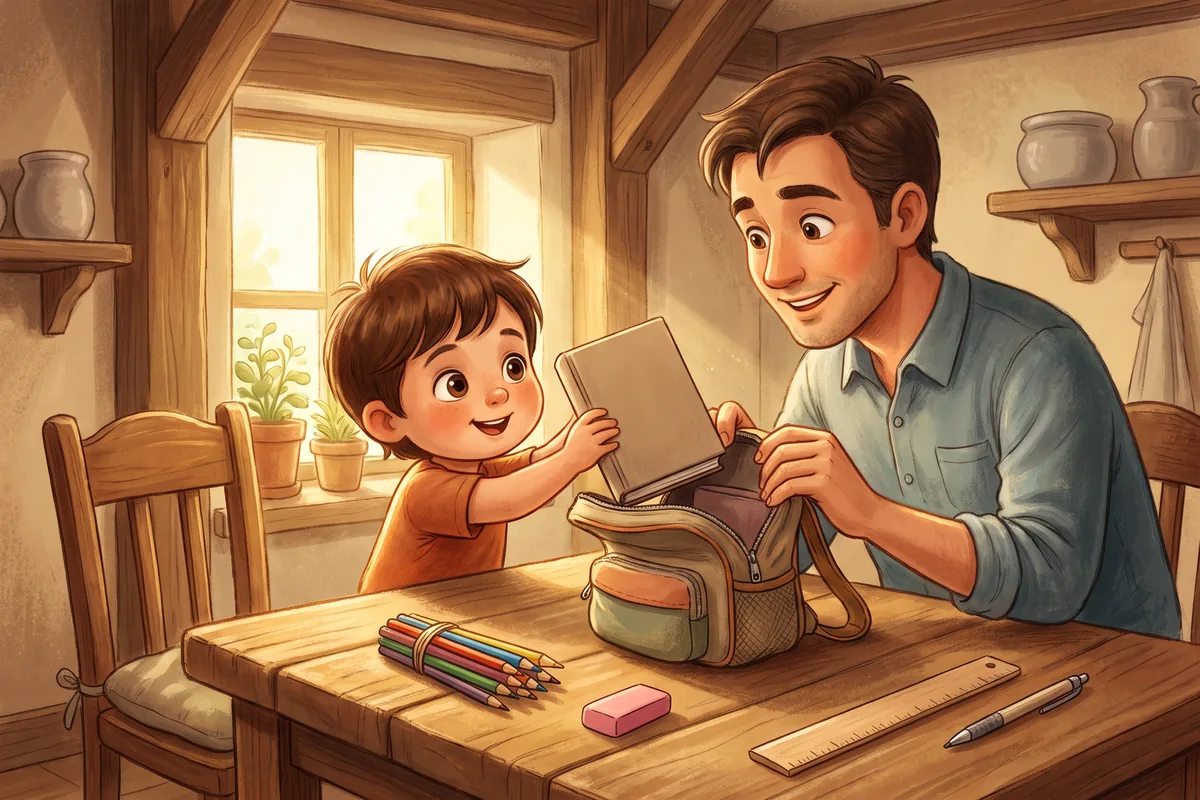
Book, pencil, pen, ruler and eraser are useful school supplies in English. Add school bag, desk and chair to talk about a classroom. Practise a name inside a short request, such as "Can I have a pencil, please?"
- Learning language
- English
- Level
- beginner
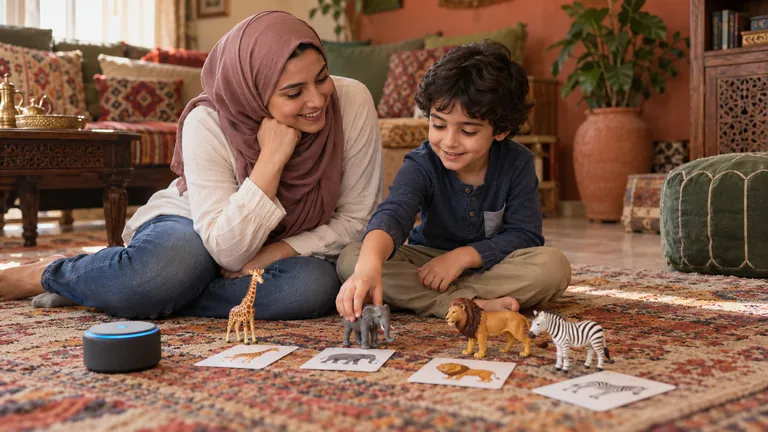
School vocabulary becomes easier to use when there is something to ask for. A pencil can be missing from a picture bag, a book can be on a desk, or a toy can need a chair. These small situations give parents a script even if English is not the language they use at home.
| English | Pronunciation (US IPA) | Meaning or use | Example |
|---|---|---|---|
| book | /bʊk/ | Pages joined together for reading or writing. | The book is on the desk. /ðə bʊk ɪz ɑn ðə dɛsk./ |
| pencil | /ˈpɛnsəl/ | A tool with a solid core for writing or drawing. | Can I have a pencil, please? /kæn aɪ hæv ə ˈpɛnsəl, pliz?/ |
| pen | /pɛn/ | A tool that writes with ink. | This is my pen. /ðɪs ɪz maɪ pɛn./ |
| ruler | /ˈɹulɚ/ | A tool for measuring length or drawing straight lines. | Here is a ruler. /hiɹ ɪz ə ˈɹulɚ./ |
| eraser | /ɪˈɹeɪsɚ/ | Something used to remove pencil marks. | I need an eraser. /aɪ nid æn ɪˈɹeɪsɚ./ |
| school bag | /skul bæɡ/ | A bag for carrying school things. | The book is in my school bag. /ðə bʊk ɪz ɪn maɪ skul bæɡ./ |
| desk | /dɛsk/ | A table used for work or study. | My pencil is on the desk. /maɪ ˈpɛnsəl ɪz ɑn ðə dɛsk./ |
| chair | /tʃɛɹ/ | A seat for one person, usually with a back. | The chair is by the desk. /ðə tʃɛɹ ɪz baɪ ðə dɛsk./ |
Broad US IPA is a reading aid. Listen to the audio for connected speech.
Eraser is common in North American English; rubber is also used in British English for this school object. Choose one word for your first activity and recognise the other when it appears. Oxford: eraser.
| English | Pronunciation (US IPA) |
|---|---|
| Can I have a pencil, please? | /kæn aɪ hæv ə ˈpɛnsəl, pliz?/ |
| I need an eraser. | /aɪ nid æn ɪˈɹeɪsɚ./ |
| Here you are. | /hiɹ ju ɑɹ./ |
| Thank you. | /θæŋk ju./ |
| Where is my book? | /wɛɹ ɪz maɪ bʊk?/ |
| It's in your school bag. | /ɪts ɪn jɔɹ skul bæɡ./ |
Broad US IPA is a reading aid. Listen to the audio for connected speech.
Use an eraser because eraser begins with a vowel sound; use a pencil and a ruler. For a whole group, say "school supplies" or "school things". Reuse the request rather than asking a child to memorise a grammar explanation.
Oxford lists a /s/ sound in the US pronunciation of eraser and a /z/ sound in the UK pronunciation. Both are useful models. Use the eraser entry to check the version you model.
Say "an eraser" together, then put it in "I need an eraser." If your child points instead, say the line yourself while passing the picture. A written pronunciation hint does not show every accent difference.
- [English Alphabet for Kids: A-Z Letters and Simple Games](/learn/alphabet/)
- [Numbers in English for Kids: 0–20](/learn/numbers/)
- [How to Help Your Child Learn a Language When You Do Not Speak It Well](/en/guides/help-child-learn-language-when-parent-does-not-speak-it/)
Play: School supplies in English: words and useful requests
Keep learning through play — the Nativik app has even more learning games and adventures. Try it!
Nativik introduces words and phrases across a range of game settings. After playing together, return to the school pictures here and let your child choose an object to name. Supply its English name and try a line such as "This is my pencil." You can turn it into a short exchange by asking for the picture.
You can use paper pictures throughout. Keep real writing tools with the adult when needed, and omit objects your child does not use. A pretend classroom is enough; the activity does not depend on school enrolment.
Pack the picture bag
- Goal
- Name and select school things.
- Preparation
- Draw an open bag and pictures of a book, pencil and ruler.
Steps
- Say the name of each picture and place it beside the bag.
- Ask, "Where is the book?" Let your child put the book inside the outline.
- Describe the result: "The book is in the school bag." Invite the child to choose what to pack next.
- Adult help
- Leave the whole set visible so your child can compare pictures.
- Easier variation
- Pack one book picture together.
A drawing desk
- Goal
- Use a request to obtain an object.
- Preparation
- Use a sheet of paper and two familiar drawing tools, or their pictures.
Steps
- Model asking for a pencil and passing it: "Can I have a pencil, please?" / "Here you are."
- Draw something together, then offer another tool or picture.
- Swap roles. Accept a point or a word as the request and supply the English line.
- Adult help
- Keep access to the drawing activity independent of pronunciation. You can hand over a tool before finishing your model sentence.
- Easier variation
- Use just pencil and "please".
The forgetful puppet
- Goal
- Practise "I need...".
- Preparation
- Draw a puppet at a desk, with an empty space where its book should be.
Steps
- Give the puppet a voice: "I need a book."
- Let your child choose a book picture and put it near the puppet.
- Now let the child choose what the puppet needs. Follow their clue and name the item.
- Adult help
- Keep the puppet's problem small and easy to solve. Avoid treating a real missing school item as a language test.
- Easier variation
- Show the book and pencil, then point to the book while saying its name.
Should we teach rubber or eraser? Either can fit your child's learning materials. Explain once that both can name the same pencil-mark remover, then use one consistently during the game.
Do we need to read the labels? No. Use pictures and spoken names. Reading labels can be an extra choice for a child who wants it.
What if my child does not go to school yet? Use a drawing desk or a fictional classroom. Pick words relevant to play, without making the activity a school-readiness test.