Nature vocabulary in English: words for looking and drawing
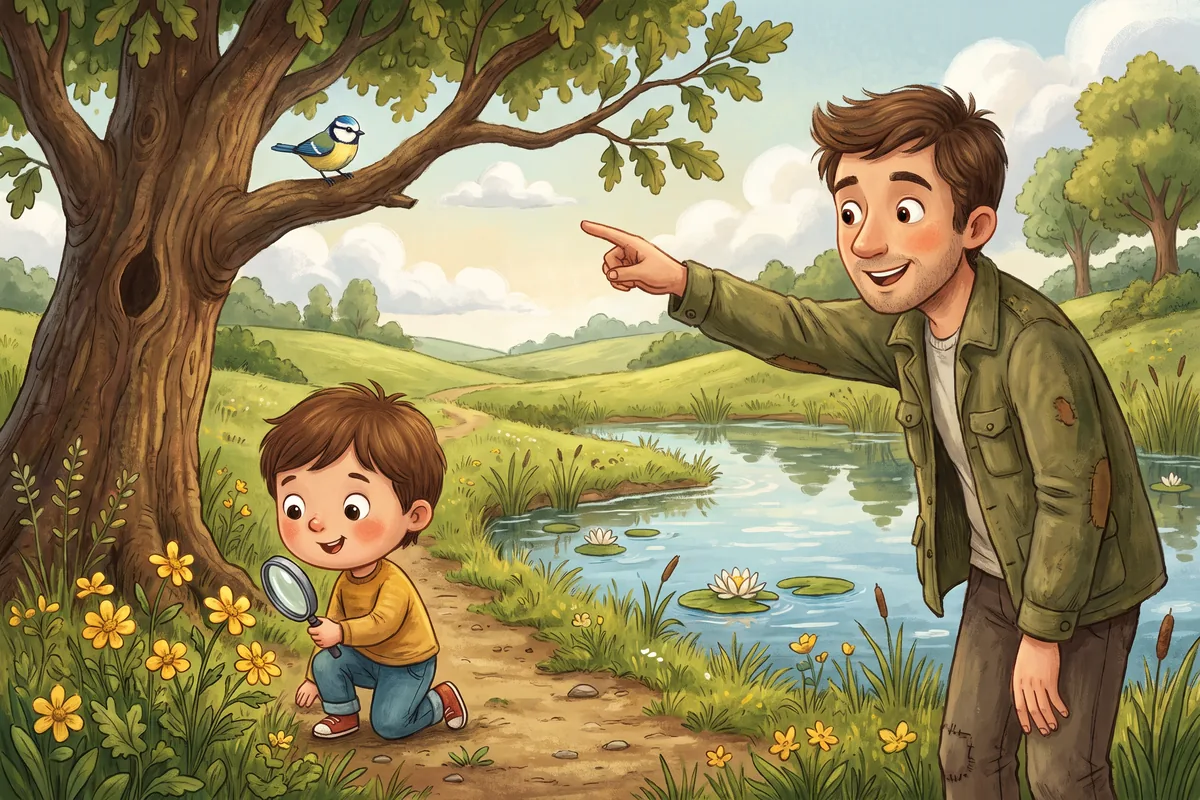
Tree, leaf, flower, grass, river and mountain are useful nature words in English. Use "I can see a tree" to name something in view, then add a colour or number if you want. A window view, drawing or book picture can supply the whole activity.
- Learning language
- English
- Level
- beginner

A small view can hold several things to name: a tree, a patch of grass, perhaps a flower. Other words, such as mountain or sea, may be easier to explore in a drawing. You can practise noticing and naming without collecting objects or making a special trip.
| English | Pronunciation (US IPA) | Meaning or use | Example |
|---|---|---|---|
| tree | /tɹi/ | A plant with a woody trunk and branches. | I can see a tree. /aɪ kæn si ə tɹi./ |
| leaf | /lif/ | A flat part of a plant, often green. | This leaf is green. /ðɪs lif ɪz ɡɹin./ |
| flower | /ˈflaʊɚ/ | The part of a flowering plant that can produce seeds. | I can see a yellow flower. /aɪ kæn si ə ˈjɛloʊ ˈflaʊɚ./ |
| grass | /ɡɹæs/ | Plants with narrow leaves, often covering the ground. | The grass is green. /ðə ɡɹæs ɪz ɡɹin./ |
| river | /ˈɹɪvɚ/ | A natural flow of water along a channel. | The river is in the picture. /ðə ˈɹɪvɚ ɪz ɪn ðə ˈpɪktʃɚ./ |
| lake | /leɪk/ | An area of water surrounded by land. | I can see a lake. /aɪ kæn si ə leɪk./ |
| mountain | /ˈmaʊntən/ | A very high area of land. | The mountain is far away. /ðə ˈmaʊntən ɪz fɑɹ əˈweɪ./ |
| sea | /si/ | A large area of salt water. | The boat is on the sea. /ðə boʊt ɪz ɑn ðə si./ |
Broad US IPA is a reading aid. Listen to the audio for connected speech.
Use leaf for one and leaves for more than one: "one leaf", "two leaves". The Cambridge leaf entry lists the irregular plural.
| English | Pronunciation (US IPA) |
|---|---|
| I can see a tree. | /aɪ kæn si ə tɹi./ |
| Can you find a flower? | /kæn ju faɪnd ə ˈflaʊɚ?/ |
| Here is a leaf. | /hiɹ ɪz ə lif./ |
| There are two trees. | /ðɛɹ ɑɹ tu tɹiz./ |
| The river is in the picture. | /ðə ˈɹɪvɚ ɪz ɪn ðə ˈpɪktʃɚ./ |
| Let's draw a mountain. | /lɛts dɹɔ ə ˈmaʊntən./ |
Broad US IPA is a reading aid. Listen to the audio for connected speech.
Say "a tree", "a leaf" or "a flower" for one item. Use "some grass" for a patch of grass in these examples. Keep the sentence tied to something visible so your child can point before trying the words.
Leaf and leaves share the long vowel /iː/ in the Cambridge UK and US forms. Listen for the different endings when you check leaf and leaves: /liːf/ and /liːvz/.
Draw one leaf, then two leaves, and model each phrase. The symbols are an adult reference; a child does not need to read them. A written reminder cannot reproduce a sound model, so check the pronunciation before introducing an unfamiliar word.
- [Animals in English for Kids: 12 Names and Three Games](/learn/animals/)
- [Colors in English for Kids: Words and Two Simple Games](/learn/colors/)
- [How to Help Your Child Learn a Language When You Do Not Speak It Well](/en/guides/help-child-learn-language-when-parent-does-not-speak-it/)
Play: Nature vocabulary in English: words for looking and drawing
Keep learning through play — the Nativik app has even more learning games and adventures. Try it!
Our playground scene has trees, grass and small flowers around the play equipment. Look for a tree together and use "I can see a tree." Your child can point to another tree or choose a flower for you to name. Continue with a drawing afterwards, adding a river or mountain if you want to use more words from the list.
Use a view from indoors or a picture whenever it is more convenient. If you go outdoors, keep the English activity within an outing you already consider suitable. Looking and pointing are enough; nothing needs to be picked up or touched.
Name a small view
- Goal
- Use "I can see..." with something visible.
- Preparation
- Choose a window view or an illustrated page.
Steps
- Point to one familiar thing and say, "I can see a tree."
- Invite your child to point to another thing from the list.
- Supply its English name, then add a detail if useful: "A yellow flower."
- Adult help
- Stay with things you can identify. Use the English nature word without guessing a plant species.
- Easier variation
- Use a page with only a tree and flower.
A landscape together
- Goal
- Connect words with a drawing.
- Preparation
- Keep a large sheet of paper and drawing tools ready.
Steps
- Draw a river and name it.
- Let your child choose whether to add a tree, lake or mountain. Say the chosen word.
- Take a picture tour with your finger: "I can see a river. I can see a mountain."
- Adult help
- Follow the child's invented landscape. It does not need to be a map of a real place.
- Easier variation
- Add and name one feature.
One leaf, two leaves
- Goal
- Practise a useful irregular plural.
- Preparation
- Draw one leaf on one sheet and two leaves on another.
Steps
- Point and say, "One leaf. Two leaves."
- Ask for either picture and let your child pass it to you.
- Swap roles. The child can hold up a picture while you name it, or join in with a word.
- Adult help
- Use drawings instead of collecting leaves. Keep the contrast about number and language.
- Easier variation
- Name leaf only and leave the plural for another time.
Do we need a garden? No. A book picture, drawing or window view gives you things to name. Mountains and lakes can stay on paper.
Should we learn the name of every tree? The general word tree is enough for the activity. Add a specific plant name only when it is useful and you have checked it.
Can a child point instead of saying the word? Yes. Name the object they point to and continue looking or drawing together. You can offer the full sentence without requesting a repeat.