Personal hygiene vocabulary in English for children
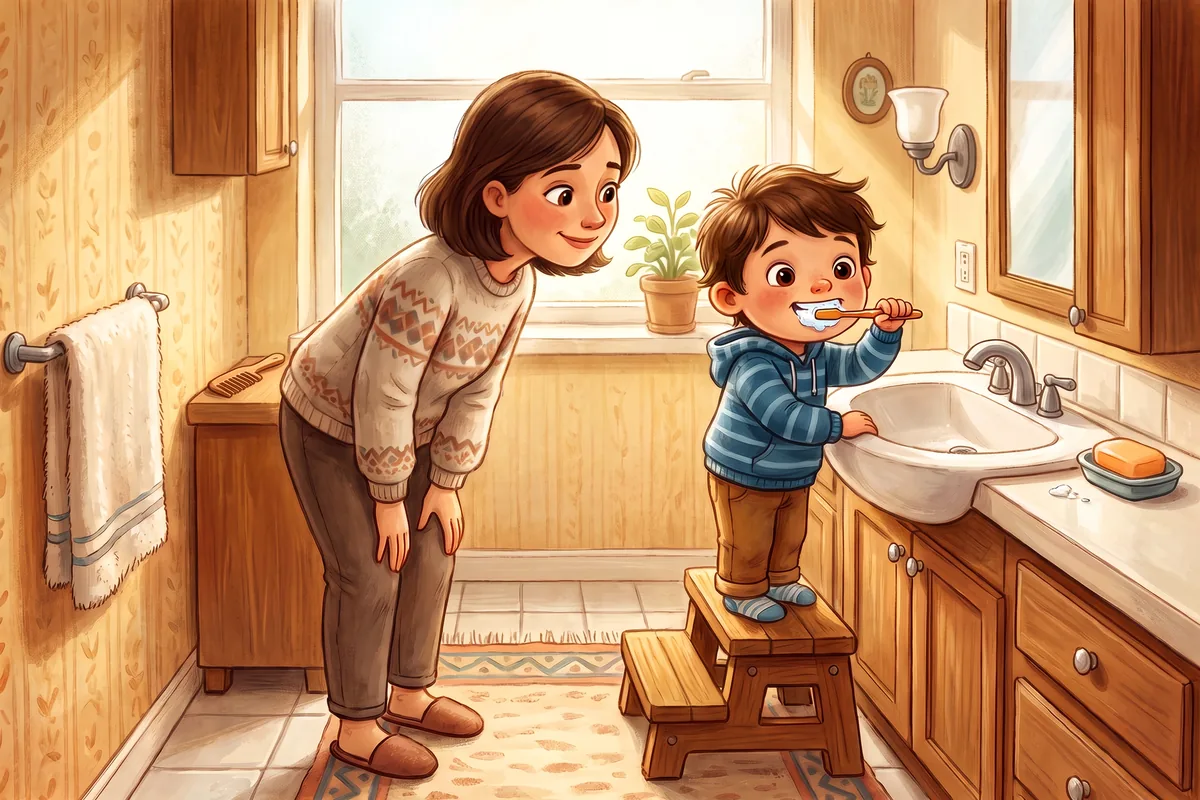
Soap, towel, toothbrush and toothpaste are useful personal hygiene words in English. Pair them with actions such as wash, rinse, dry and brush. Pictures let you practise the language without changing your family's care routine or handling toiletries during the activity.
- Learning language
- English
- Level
- beginner
A towel has a name, and drying has an action word. Linking the two can help you describe an ordinary moment in English. You can do that with paper pictures, keeping personal care in the language and routine that work for your family.
| English | Pronunciation (US IPA) | Meaning or use | Example |
|---|---|---|---|
| soap | /soʊp/ | A substance used with water for washing. | Here is some soap. /hiɹ ɪz sʌm soʊp./ |
| water | /ˈwɔtɚ/ | The liquid used here for washing or rinsing. | The water is in the picture. /ðə ˈwɔtɚ ɪz ɪn ðə ˈpɪktʃɚ./ |
| towel | /ˈtaʊəl/ | A cloth used for drying. | Here is a towel. /hiɹ ɪz ə ˈtaʊəl./ |
| toothbrush | /ˈtuθbɹəʃ/ | A small brush used to clean teeth. | This is a toothbrush. /ðɪs ɪz ə ˈtuθbɹəʃ./ |
| toothpaste | /ˈtuθpeɪst/ | A paste used with a toothbrush for cleaning teeth. | This is toothpaste. /ðɪs ɪz ˈtuθpeɪst./ |
| comb | /koʊm/ | A tool with a row of teeth, used for hair. | This is my comb. /ðɪs ɪz maɪ koʊm./ |
| wash | /wɑʃ/ | Clean using water, often with soap. | I wash my hands. /aɪ wɑʃ maɪ hændz./ |
| rinse | /ɹɪns/ | Use water to remove soap or dirt. | I rinse my hands. /aɪ ɹɪns maɪ hændz./ |
| dry | /dɹaɪ/ | Remove water or moisture. | I dry my hands. /aɪ dɹaɪ maɪ hændz./ |
| brush | /bɹʌʃ/ | Clean or tidy with a brush. | I brush my teeth. /aɪ bɹʌʃ maɪ tiθ./ |
Broad US IPA is a reading aid. Listen to the audio for connected speech.
Soap can name a liquid or a solid bar. In these examples, say some soap or a bar of soap. The Cambridge soap entry gives both uses.
| English | Pronunciation (US IPA) |
|---|---|
| Here is a towel. | /hiɹ ɪz ə ˈtaʊəl./ |
| Where is the toothbrush? | /wɛɹ ɪz ðə ˈtuθbɹəʃ?/ |
| I wash my hands. | /aɪ wɑʃ maɪ hændz./ |
| I rinse my hands. | /aɪ ɹɪns maɪ hændz./ |
| I dry my hands. | /aɪ dɹaɪ maɪ hændz./ |
| I brush my teeth. | /aɪ bɹʌʃ maɪ tiθ./ |
Broad US IPA is a reading aid. Listen to the audio for connected speech.
Use my when describing your own action: "I wash my hands" and "I brush my teeth". Teeth is the plural of tooth. The phrases describe language examples; use the care instructions already appropriate for your child.
Toothbrush contains the /θ/ sound in tooth and the /ʃ/ sound in brush in Cambridge's UK and US form /ˈtuːθ.brʌʃ/. Rinse ends with /ns/ in /rɪns/. See toothbrush and rinse.
Check a pronunciation model yourself, then say the whole word while pointing to a picture. Try "a toothbrush" before "I brush my teeth". The symbols are an adult reference, and a child can choose the picture without repeating.
- [Body Parts in English for Kids](/learn/body-parts/)
- [Days of the week in English for kids](/learn/days-of-the-week/)
- [How to Help Your Child Learn a Language When You Do Not Speak It Well](/en/guides/help-child-learn-language-when-parent-does-not-speak-it/)
Play: Personal hygiene vocabulary in English for children
Keep learning through play — the Nativik app has even more learning games and adventures. Try it!
The bathroom area in our home scene includes a sink, bath and hanging towels. When you look at it together, point to a towel and say "Here is a towel." Then use your paper pictures to ask "Where is the toothbrush?" and talk about the care objects your family uses. Keep the language practice separate from carrying out a care routine.
Use drawings for toiletries and actions. Leave products closed and out of the game; tasting, opening containers or using water is unnecessary. You can explain each picture in your home language before modelling its English name.
A paper wash bag
- Goal
- Recognise personal-care objects.
- Preparation
- Draw a large bag outline and pictures of a towel, toothbrush, toothpaste and comb.
Steps
- Name each picture and place it beside the bag.
- Ask, "Where is the toothbrush?" Let your child put that picture in the bag.
- Invite your child to choose the next item. Say its name or "Here is a towel" as you pass it.
- Adult help
- Use paper only. The task is naming objects, not deciding what every child must pack or use.
- Easier variation
- Offer towel and toothbrush pictures only.
Object and action pairs
- Goal
- Connect a noun with a useful verb.
- Preparation
- Draw a towel beside drying hands, and a toothbrush beside a tooth-brushing picture.
Steps
- Point to the towel and say, "A towel. I dry my hands."
- Let your child put the matching pictures together.
- Try the other pair and model its phrase. Swap roles so the child can ask you to match.
- Adult help
- Keep the pictures neutral. No body inspection, personal demonstration or performance of care is required.
- Easier variation
- Name only the objects before adding action pictures.
The paper character's hands
- Goal
- Hear wash, rinse and dry in a sequence.
- Preparation
- Draw a character's hands and three simple action pictures labelled wash, rinse and dry.
Steps
- Explain that you are telling a pretend picture story.
- Point to each action in sequence and say, "I wash my hands. I rinse my hands. I dry my hands."
- Let your child point to the next picture or move the character's paper hand beside it. Repeat a word if invited.
- Adult help
- Treat this as vocabulary, not a complete handwashing demonstration or a timing rule. Keep real care separate from the game.
- Easier variation
- Use wash and dry pictures only.
Do we need to practise during actual washing or brushing? No. Pictures let you focus on the language. Use English in real care only when it is comfortable and does not complicate the task.
Is this a complete hygiene routine? No. The examples explain words. They do not specify how often, how long or which products a child should use.
What if my child dislikes an action or will not act it out? Stay with pictures, let the child choose another word or stop. Naming a toothbrush does not require pretending to brush or showing teeth.