What Age Should a Child Start Learning a Foreign Language?
Deciding when to introduce English means considering your child's interest and the languages and routines already at home. This guide looks at starting at ages 3–5, 6–8 and 9–10, with a simple first activity for each family to adapt. There is no single age at which a child must begin.
- Age
- Ages 3–10
The American Academy of Pediatrics and American Speech-Language-Hearing Association explain that older children can also learn additional languages. This supports beginning without a missed-window message; it does not promise a particular outcome. AAP/ASHA parent guidance.
An earlier start is not automatically a better foreign-language course. A preschool research review reports uneven evidence, slow early progress in many programs, and the importance of meaningful interaction and the language children actually encounter. Nikolov and Mihaljević Djigunović, 2023.
For this decision, treat readiness as a practical question: can you offer an activity the child is willing to join, with meaning you can show and a routine you can repeat? Joining might mean watching, pointing or moving a toy—not answering in English. This is a way to choose an activity, not a developmental assessment.
First separate three situations. Home bilingualism involves languages used in family life. Immersion involves substantial contact through school or community life. Limited foreign-language lessons may provide much less contact. A result from one setting cannot simply predict another. Preschool review: context distinctions.
| Family purpose | A possible first step | Avoid assuming |
|---|---|---|
| Maintain a family or heritage language | Keep using it in ordinary conversations and shared routines. | A home language needs to wait until school age. |
| Explore English or another foreign language | Try one familiar interaction with an object and a useful phrase. | Trying a language requires buying a course. |
| Support school lessons | Ask what the class is working on and choose a related spoken exchange. | A later beginner needs a catch-up race. |
| Prepare for a move or immersion program | Ask the setting how it will support understanding and participation. | An occasional home activity is equivalent to immersion. |
Head Start recommends maintaining the home language while English develops and using languages adults speak comfortably. Head Start home-language guidance.
Apply that distinction to your own family: adding an English greeting need not replace a full conversation in Russian, Spanish or another home language. Keep the languages you use for stories, questions and comfort; add a manageable opportunity to encounter the new one.
| Age scenario | One possible starting action | Participation you could accept |
|---|---|---|
| 3–5 | Make a toy greet the child, then point together to a familiar object. | Watching, pointing, moving the toy or voluntarily copying a word. |
| 6–8 | Offer a choice between two familiar objects while naming them. | Choosing or passing an object; speaking is optional. |
| 9–10 | Choose a useful exchange linked to an interest, and explain its meaning if helpful. | Trying either role, asking a question or identifying the phrase. |
Ages 3–5: make the invitation concrete
Start with something already in the child’s play rather than a worksheet. Show what your words refer to. When the child turns away or the exchange becomes frustrating, simplify it or leave it for another occasion; do not use compliance as a test of language-learning potential.
Ages 6–8: offer structure when it helps
Try a clear choice or turn-taking exchange instead of asking for a list of words. Add a written word only when it suits this child. A child who enjoys an object-based activity can keep using it; a birthday does not require a switch to formal lessons.
Ages 9–10: start from interests and existing skills
Invite the child to help choose the purpose: greeting someone, joining a game or asking for an object. Use explanations or print when useful, without assuming every child reads confidently. An older beginner does not need to copy a preschool activity—or begin with grammar drills.
Before committing to a program, choose a small entry point. These suggestions are for deciding how to begin, not a prescribed first-week schedule.
- **Choose one recurring situation.** A greeting during play is enough for an initial attempt; no vocabulary quota is necessary.
- **Show the meaning.** Hold the object or demonstrate the action as you say the phrase, rather than asking the child to guess.
- **Make room for a response.** Accept a look, gesture or choice. Invite speech without making repetition the price of continuing.
- **Check the fit.** Ask whether the activity was comfortable for both of you and whether it has a realistic place in family life. Simplify before adding more.
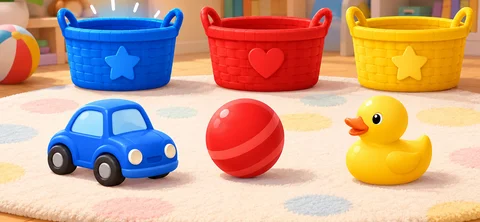
You do not need an app, recording, download or reading task for the example below. A familiar toy, a ball and your voice are the complete materials. This is an invitation to share meaning, not an assessment of how much English the child has learned.
Decide what would make the next encounter easier, rather than counting words or comparing starting ages.
- **Continue informally** when the child is comfortable and you can repeat the interaction without strain.
- **Consider a teacher or course** when you need help choosing language, modeling it or providing interaction. Ask how beginners participate without already reading or speaking English.
- **Adjust the format** when the child dislikes the activity. Offer a different object, a clearer demonstration or a topic the child chooses; do not conclude that language learning is impossible.
- **Use existing skills** when the child enjoys explanations or print, while keeping a listening-and-interaction option.
Before choosing a program, ask: Why this language now? Where will my child encounter it? What will they do with it? Can we maintain our home languages and a workable routine? Compare those answers, not just the youngest age printed on an advertisement.
In an English–Dutch study, children first exposed to Dutch at 1–3 and 4–7 did not differ significantly on the tested measures; current exposure related to most scores. This was not an English-course trial. Unsworth, 2016.
Among Spanish–English kindergarteners, current language input and use explained more variation in speech-sound accuracy than age of first English exposure. This association is not a causal rule for all language skills. Ruiz-Felter and colleagues, 2016.
A classroom study in Russia and China compared children who started English at 4 or 7 and were tested five years later, at 9 or 12. Later starters performed better on the verb forms tested. The schools shared a curriculum framework, but teaching hours and age-specific materials differed. This does not establish an ideal starting age for every child. Ntalli and colleagues, published online in 2025.
These findings do not show that age never matters or that waiting is better. The studies differ in setting, language and outcome; they cannot establish one ideal English-starting age, a daily dose or a guaranteed speed of progress. Preschool review; child Dutch study; classroom English study.
Try this as an optional first encounter, not a lesson your child must pass. Adapt the way the child joins to what is comfortable and accessible for them.
Say hello and look at the ball
- Goal
- Introduce an English greeting and a phrase whose meaning you can show.
- Preparation
- Bring a familiar toy and a ball the child already uses. No recording, picture download or reading is needed.
Steps
- Greet the toy with “Hello” and a wave. Let the toy turn toward the child.
- Put the ball beside the toy. Say “Look at the ball” while clearly pointing to it.
- Pause. Accept looking, pointing or moving the toy toward the ball. Welcome a voluntary “Hello” or “ball,” but do not request a spoken answer.
- Continue the pretend interaction if the child chooses to join. Otherwise, end it without a test or correction routine.
- Adult help
- Show the meaning with the objects and gestures. Explain the setup in your comfortable home language if needed; there is no requirement to conduct the whole interaction in English.
- Easier variation
- Use only the toy and “Hello.” A look or wave can be the child’s whole contribution.
Afterward, notice whether the interaction was easy to share and worth trying again. Pointing after a demonstration may be following your gesture; it is not proof that a phrase has been learned.
Is seven too late to start English?
No. Older children can learn additional languages, according to AAP/ASHA guidance; seven is not a universal missed deadline. This does not guarantee the same progress or eventual proficiency for every learner. AAP/ASHA parent guidance.
Must my child read first?
Not for the spoken first-contact example here: it uses a toy, a ball, gestures and your voice. Choose a non-reading activity when appropriate; particular courses may have their own entry requirements.
Should we stop using our home language to make room for English?
Head Start recommends supporting the home language alongside English. Do not treat an additional language as a reason to abandon the language of family communication. Head Start guidance.
What if my child does not speak during the activity?
For this activity, accept pointing or watching, or stop when the child does not wish to join. No English-speaking deadline is attached to the example.
AAP/ASHA states that learning multiple languages does not itself cause a speech or language disorder. Concerns about your child’s communication warrant discussion with a pediatrician or speech-language professional; this activity cannot diagnose or rule out a difficulty. AAP/ASHA guidance on communication concerns.